Qingyuan moksha Biotechnology Co., Ltd


Body scrubs are sold on a sensation that lasts about thirty seconds, and the whole product brief comes down to whether those thirty seconds feel right. A scrub that drags is abandoned; one that dissolves before the user finishes a leg is judged underpowered. In an exfoliating product, the sensory event is the product, so the abrasive specification is the brief. This guide covers abrasive selection, suspension stability, viscosity and the claim boundaries that apply.
Choosing the Abrasive
Abrasives divide broadly into water-soluble and insoluble types. Sugar and salt dissolve as the product is used, so friction softens progressively and the experience ends gently. Ground nut shells, seeds and synthetic beads do not dissolve, so friction stays constant throughout the application. Soluble abrasives suit frequent-use positioning, while insoluble abrasives suit a stronger, more occasional treatment.
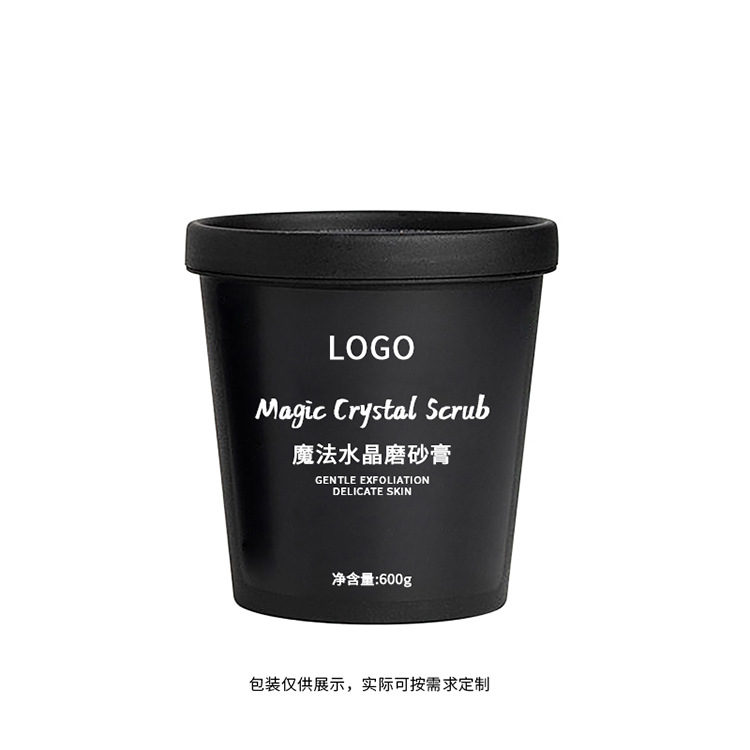
Particle size distribution matters more than the material name. A wide distribution gives an uneven feel, with coarse particles dominating the sensation regardless of the average. Specify a size range rather than an average, because the sensation is driven by the larger particles. Formats in the current range include this body scrub reference.
Regulatory and Sustainability Considerations
Some synthetic abrasives are restricted or voluntarily excluded in a number of markets on environmental grounds, and the list has grown over time. Any product intended for export needs its abrasive checked against each destination market before the formula is fixed. Confirm the abrasive against every target market during concept development, because changing it later invalidates the sensory work already done.
Natural alternatives avoid that particular constraint but introduce others: wider particle size variation and a higher microbiological load at receipt. Natural abrasives usually require tighter incoming specifications, not less testing. A related exfoliating wash format is shown in this fruit acid body wash reference.
Chemical and physical exfoliation together
Many modern products combine a physical abrasive with a chemical exfoliating agent. The combination changes the sensory profile and raises a compatibility question with the gelling system and the preservative. Treat the combination as a new formula requiring its own stability work rather than as an additive tweak.
Suspension Stability and Viscosity
Particles have to stay distributed throughout the base. If the abrasive is denser than the continuous phase it sinks; if it is lighter it rises. Either way, the user receives a product with an uneven particle count per application. Suspension stability is the defining quality attribute of a scrub and should be checked over the full shelf life, not just after production.
Viscosity has to satisfy two opposing requirements: high enough to suspend particles and prevent run-off during use, low enough to be dispensed from the pack and spread across the body without dragging. The practical target is the lowest viscosity that still holds the particles in suspension. A yield-stress gelling system usually solves this better than a simple thickener.
Sensory Targets and How to Measure Them
Three sensory attributes carry most of the consumer judgement: initial drag, the rate at which the abrasive breaks down, and how the skin feels after rinsing. Each can be compared across variants with a small panel using fixed test sites and a fixed quantity of product. Standardising the dose per test site removes most of the noise from sensory comparison.
The rinse-off result depends heavily on the emollient system, because the scrub has a short contact time and its conditioning effect appears afterwards. Judging a scrub at the moment of application alone ignores the part the user remembers. Performance should also be checked in the water hardness of the target market, since surfactant behaviour changes with mineral content.
Pack Format and Claims
Scrubs are usually sold in jars or wide-mouth tubes. A jar allows the user to take a visible scoop and reinforces the treatment positioning, but it exposes the product to water ingress in the shower. A tube limits contamination but can struggle to dispense a dense base. Choose the pack against the shower environment rather than against the shelf, because that is where the product lives.
Claims for exfoliating products are the easiest to push past the limit, particularly wording that implies a change to the skin's structure or a therapeutic effect. Wording should stay with the appearance of the skin and the experience of use. Net content accuracy also matters here, because the abrasive content makes even filling harder than in a plain wash. Manufacturing conditions are described in the workshop overview, and the wider range is listed in the product range.
A body scrub has no room to hide a weak decision: the consumer feels the specification immediately. Fix the abrasive size range, prove the suspension holds, tune viscosity to the pack, and keep the claims tied to appearance and experience. Submit your brief through the contact page to begin sampling.
Frequently asked questions
Can you produce Body Scrub and Exfoliating Wash OEM under our own brand?
Body Scrub and Exfoliating Wash OEM is handled as a private label project: you bring the brand and the market position, we cover formula, bulk, filling and packing. Existing bases can be adjusted for texture, fragrance and active level, or we develop from a new brief. Tooling and artwork belong to you, and our name does not appear on the pack.
What is the minimum order quantity?
MOQ is set by net fill per unit, not by category:
| Net fill | MOQ |
|---|---|
| < 15 ml/g | 5,000 pcs |
| 15-50 ml/g (50 included) | 3,000 pcs |
| 50-200 ml/g (200 included) | 2,000 pcs |
| > 200 ml/g | 1,000 pcs |
Several SKUs in one project can share a production run to reach the threshold, and a smaller trial order is possible once the formula is approved.
How long do samples and bulk production take?
Samples take 7-10 working days from a confirmed brief, or 10-15 days when a new mould or artwork is involved. Bulk runs 25-35 days after sample approval and packaging arrival. Repeat orders with an unchanged formula usually move faster.
Which certificates and documents come with the shipment?
The plant runs under GMPC and ISO 22716 with a 100,000-class cleanroom. Each shipment can include COA, MSDS, the full INCI list, stability data and microbiological reports. For the EU we support CPSR and PIF paperwork; for other markets we prepare the file set your importer asks for.
Can we change the formula, fragrance or packaging?
Yes. Texture, viscosity, fragrance, colour and active percentage are adjustable within regulatory limits. Packaging can be sourced by you or by us: tubes, airless bottles, jars, sachets and aluminium foil bags, with silkscreen, hot stamping or label application.
What information do you need to quote?
Category and target function, quantity per SKU, packaging direction, destination market and launch date. With that we reply within 24 hours on business days with feasibility, MOQ and a price range. An NDA can be signed before formulas are discussed.
Need this produced? Talk to the factory.
Wangsha Bio has run OEM/ODM production since 2006: 60,000 sqm plant, 17 lines, 100,000-class cleanroom, GMPC and ISO 22716 certified. Send your brief and we reply within 24 hours on business days with feasibility, MOQ and a price range.
Email lucky@moksha-bio.com | Product range | Workshop