Qingyuan moksha Biotechnology Co., Ltd


Pet grooming is one of the easier adjacencies for a cosmetics factory to enter, because the equipment, the filling lines and much of the surfactant supply chain are already in place. It is also one of the easier ones to get wrong, because formulators used to human skin often carry over assumptions that do not hold: the pH target is different, the coat is a fibre rather than a surface to be moisturised, and the animal will lick itself afterwards. This guide sets out what a private label pet shampoo brief should specify.
Why pet shampoo is not human shampoo in a larger bottle
Human skin sits around pH 4.5 to 5.5. Dogs and cats sit closer to neutral, roughly 6.5 to 7.5 depending on the site and the breed, and their skin is thinner in the stratum corneum relative to body size. A shampoo formulated at pH 4.5 for human hair is not automatically suitable for a dog, and the acid mantle argument that drives human product design does not transfer cleanly.
The coat matters as much as the skin. Conditioning agents that make human hair feel smooth can weigh down a double coat and reduce its insulating function, and heavy silicones accumulate on a coat that is only bathed every few weeks. Meanwhile the animal grooms itself, so anything left on the coat is eventually ingested. That single fact reshapes the whole preservative and fragrance decision.
Surfactant systems and the dilution question
Most pet shampoos are built on the same surfactant families as human products: cocamidopropyl betaine for mildness and foam, lauryl or laureth sulfates for cleansing power, and glucosides for a gentler premium tier. The difference is usually the ratio, not the ingredient list. Pet coats carry more soil, more sebum and more odour-causing material than human hair, so cleaning power is weighted higher than in a baby shampoo, while irritation potential still has to stay low because the product touches ears, paws and sometimes broken skin.
Concentrates are common in professional grooming channels and are diluted at the tub. If the product is sold as a concentrate, the dilution ratio has to be specified on the label and validated in the lab, including how the diluted solution behaves over a working day. A concentrate that separates after two hours in a spray bottle creates complaints that have nothing to do with the formula itself.
pH, mildness and the tear-free claim
Set a pH window explicitly in the brief. For general pet shampoos, 6.0 to 7.5 is a practical target that balances mildness with preservative performance and fragrance stability. Puppy and kitten lines often move closer to 7, with a reduced surfactant load. Medicated-adjacent formats require their own review and should not be positioned with veterinary language unless the registration path supports it.
Tear-free positioning is achieved the same way as in human products: by choosing amphoteric and non-ionic surfactants and keeping the total active matter moderate. The claim still needs eye irritation testing, and it should be limited to the species and use case that was actually tested.
Odour control and fragrance safety
Odour is the reason most owners buy a pet shampoo, so the fragrance brief carries unusual weight. Two things need to be separated: cleaning away the source of the odour, and covering it with scent. Products that only mask tend to disappoint within a day. A slightly higher surfactant load plus a rinse that actually reaches the undercoat does more for odour than a stronger fragrance.
Fragrance safety is the part that requires discipline. Several essential oils that are common in human products are poorly tolerated by cats, whose liver cannot process certain terpenes and phenols, and tea tree, citrus, peppermint and pennyroyal are the usual examples. A fragrance house can supply a pet-safe accord with documentation, and that is a far safer route than building a scent from single oils. Levels should stay low, and the label should state that the product is for external use on animals only.
Filling, packaging and the commercial side
Pet shampoos are usually sold in larger formats than human products: 250 ml to 1 litre, with 500 ml the volume driver in most markets. That changes the economics. Bottle weight, closure type and label durability matter more than decoration, because the pack has to survive a wet bathroom, a grooming table and repeated squeezing. Flip-top closures and wide-mouth bottles with a pump are the practical choices; thin-walled decorative bottles tend to crack at the shoulder.
MOQ follows the same logic as other wash products: larger fill volumes allow lower minimum order quantities, since the batch is limited by tank size rather than by unit count. A 500 ml fill will typically reach a workable MOQ at a lower unit count than a 100 ml fill, which is one reason pet ranges are friendlier to first orders than trial-size skin care.
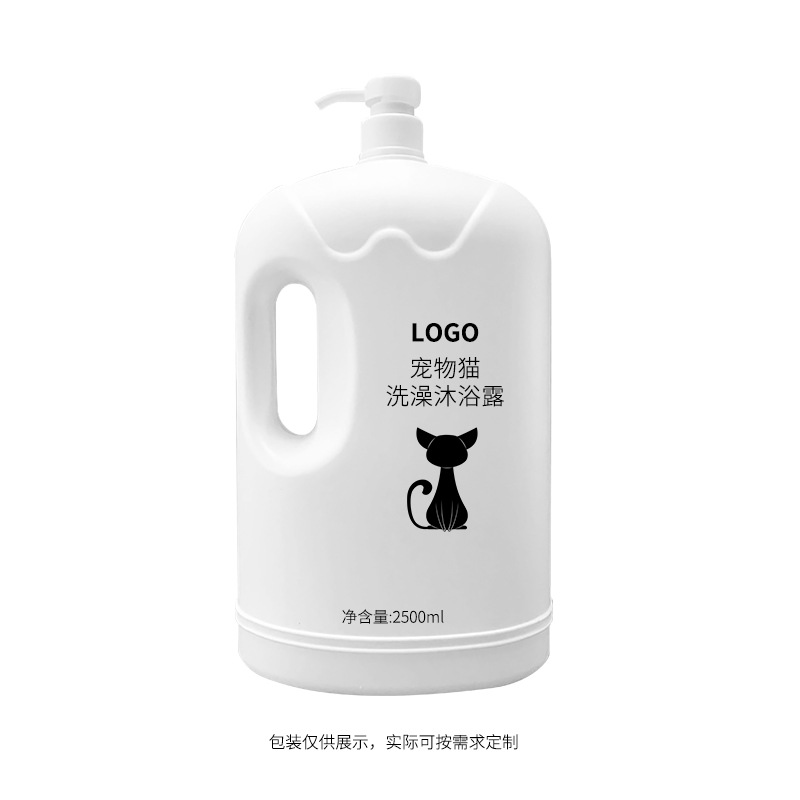
Wangsha Biotechnology produces pet grooming shampoos on the same wash lines as its personal care ranges, so a brand can develop a pet line and a human line with the same factory, the same quality system and the same export paperwork. The product catalogue shows the wider range, and a cat bathing shampoo is a useful reference for format and pack style. Buyers can review the workshop before a factory visit and send specifications through the contact page.
The summary is simple: match the pH and surfactant load to the species, keep the fragrance pet-safe and documented, and specify the dilution and pack before sampling starts. Adjacent categories reward brands that approach them as their own discipline rather than as a relabelled version of something else. Further notes on wash-off formulation appear in our industry news archive.
Frequently asked questions
Can you produce Pet Shampoo Formulation under our own brand?
Pet Shampoo Formulation is handled as a private label project: you bring the brand and the market position, we cover formula, bulk, filling and packing. Existing bases can be adjusted for texture, fragrance and active level, or we develop from a new brief. Tooling and artwork belong to you, and our name does not appear on the pack.
What is the minimum order quantity?
MOQ is set by net fill per unit: under 15 ml/g 5,000 pcs; 15-50 ml/g 3,000 pcs; 50-200 ml/g 2,000 pcs; above 200 ml/g 1,000 pcs. Several SKUs in one project can share a production run to reach the threshold.
How long do samples and bulk production take?
Samples take 7-10 working days from a confirmed brief, or 10-15 days when a new mould or artwork is involved. Bulk runs 25-35 days after sample approval and packaging arrival. Repeat orders with an unchanged formula usually move faster.
Which certificates and documents come with the shipment?
The plant runs under GMPC and ISO 22716 with a 100,000-class cleanroom. Each shipment can include COA, MSDS, the full INCI list, stability data and microbiological reports. For the EU we support CPSR and PIF paperwork; for other markets we prepare the file set your importer asks for.
Can we change the formula, fragrance or packaging?
Yes. Texture, viscosity, fragrance, colour and active percentage are adjustable within regulatory limits. Packaging can be sourced by you or by us: tubes, airless bottles, jars, sachets and aluminium foil bags, with silkscreen, hot stamping or label application.
What information do you need to quote?
Category and target function, quantity per SKU, packaging direction, destination market and launch date. With that we reply within 24 hours on business days with feasibility, MOQ and a price range. An NDA can be signed before formulas are discussed.
Need this produced? Talk to the factory.
Wangsha Bio has run OEM/ODM production since 2006: 60,000 sqm plant, 17 lines, 100,000-class cleanroom, GMPC and ISO 22716 certified. Send your brief and we reply within 24 hours on business days with feasibility, MOQ and a price range.
Email lucky@moksha-bio.com | Product range | Workshop