Qingyuan moksha Biotechnology Co., Ltd


Net content is invisible until an inspection raises it, and then it concerns an entire batch. Brand owners care whether the declared figure is compliant; manufacturers care whether the filler can hold it. The two conversations often run in parallel without meeting. Net content is both a regulatory question and a cost question: overfilling gives product away, underfilling is a violation. This guide connects accuracy, tolerances and process control.
How Net Content Is Declared and Judged
Net content declares the quantity of product excluding packaging, with unit and character height both regulated. Judgement normally uses batch sampling: the average actual content must not fall below the declared value, and no single unit may fall short by more than the permitted tolerance. Two lines have to be satisfied at once, the average and the individual shortfall, and failing either one fails the batch.
That means the filling target has to sit above the declared value, with enough headroom to absorb variation. How much headroom depends on line stability: an unstable line needs a larger margin and costs more. An oversized safety margin is a permanent giveaway, and over a year it is a substantial product loss. Formats across the range are listed in the product range.
Where Filling Error Comes From
Error has four sources: the metering accuracy of the machine, the flow behaviour of the product at its actual viscosity and temperature, the capacity consistency of bottles and pumps, and disturbance from stops and manual intervention. Before blaming the machine, rule out the product and the packaging, because those two usually offer the cheaper fix.
Viscosity effects are underrated. The same filler behaves differently on a thick cream and a thin liquid: the cream clings and traps voids, the liquid splashes and drips. A drop in ambient temperature raises viscosity, so winter and summer fills differ systematically. Seasonal adjustment of filling parameters is common practice and rarely documented, which is exactly the problem.
Batch variation in packaging
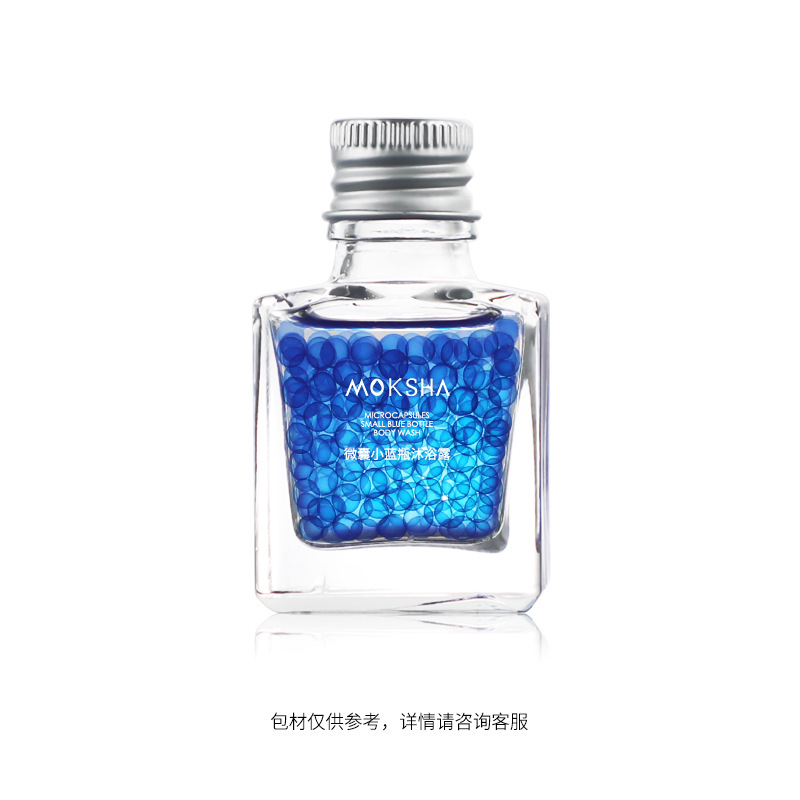
Bottle and pump capacity is not perfectly consistent, and different mould batches can differ. If capacity runs small, volumetric filling overflows; gravimetric filling may then leave the unit short. Capacity tolerance belongs in the packaging purchase specification, not in a conversation during filling. A high-volume format is this microcapsule shower gel reference.
Process Control in Practice
The standard structure is first-piece approval, in-process sampling and end-of-run verification. Approval sets the baseline, sampling watches for drift, and final checks confirm the batch landed inside the window. Sampling frequency should follow line stability rather than habit carried over from the previous product.
Gravimetric checking is the usual method: simple, cheap, and prone to accumulation error when tare weight is subtracted repeatedly. For high-value products an inline checkweigher or flow meter gives a second reference. Plotting weights against time reveals drift earlier than pass-fail records, because a trend is visible before a failure occurs. Filling and inspection conditions are described in the workshop overview.
How Net Content Drives Packaging and Cost
The declared figure feeds back into packaging choice. A 50 ml declaration with a 3 ml safety margin needs a container that holds 53 ml plus headspace, otherwise the line either overflows or the pump cannot reach the last of the product. Calculate the fill ceiling before specifying container capacity, or the tooling has to be reworked.
On cost, the higher the product value per millilitre, the more the margin hurts. At 2 ml overfill across one hundred thousand units, a serum line gives away two hundred litres. Treating the safety margin as an optimisable cost rather than an industry habit pays back quickly. Manufacturer credentials are summarised on the about us page.
Documents and Responsibility
Three documents govern net content: the specification with declared value and tolerance, the filling work instruction with parameters and sampling frequency, and the inspection record with measured data. All three must use the same numbers, or the manufacturer cannot defend a batch under challenge.
Responsibility should also be allocated in advance: who carries packaging capacity deviation, how a shortfall is judged, and how rework or scrap cost is shared. Writing this into the supply agreement is far cheaper than negotiating after an incident. Requirements can be submitted through the inquiry form.
Net content is the classic item nobody praises when it is right and everybody rejects when it is wrong. Set the tolerance properly, watch the trend rather than the single point, and align the paperwork: then it stops being a risk item.
Frequently asked questions
Can you produce Net Content Control on the Filling Line under our own brand?
Net Content Control on the Filling Line is handled as a private label project: you bring the brand and the market position, we cover formula, bulk, filling and packing. Existing bases can be adjusted for texture, fragrance and active level, or we develop from a new brief. Tooling and artwork belong to you, and our name does not appear on the pack.
What is the minimum order quantity?
MOQ is set by net fill per unit: under 15 ml/g 5,000 pcs; 15-50 ml/g 3,000 pcs; 50-200 ml/g 2,000 pcs; above 200 ml/g 1,000 pcs. Several SKUs in one project can share a production run to reach the threshold.
How long do samples and bulk production take?
Samples take 7-10 working days from a confirmed brief, or 10-15 days when a new mould or artwork is involved. Bulk runs 25-35 days after sample approval and packaging arrival. Repeat orders with an unchanged formula usually move faster.
Which certificates and documents come with the shipment?
The plant runs under GMPC and ISO 22716 with a 100,000-class cleanroom. Each shipment can include COA, MSDS, the full INCI list, stability data and microbiological reports. For the EU we support CPSR and PIF paperwork; for other markets we prepare the file set your importer asks for.
Can we change the formula, fragrance or packaging?
Yes. Texture, viscosity, fragrance, colour and active percentage are adjustable within regulatory limits. Packaging can be sourced by you or by us: tubes, airless bottles, jars, sachets and aluminium foil bags, with silkscreen, hot stamping or label application.
What information do you need to quote?
Category and target function, quantity per SKU, packaging direction, destination market and launch date. With that we reply within 24 hours on business days with feasibility, MOQ and a price range. An NDA can be signed before formulas are discussed.
Need this produced? Talk to the factory.
Wangsha Bio has run OEM/ODM production since 2006: 60,000 sqm plant, 17 lines, 100,000-class cleanroom, GMPC and ISO 22716 certified. Send your brief and we reply within 24 hours on business days with feasibility, MOQ and a price range.
Email lucky@moksha-bio.com | Product range | Workshop