
 Qingyuan moksha Biotechnology Co., Ltd


Panthenol is one of those ingredients that survives every trend cycle because its story is simple and verifiable: it converts in skin to pantothenic acid, vitamin B5, which participates in coenzyme A chemistry and the metabolism of barrier lipids. It is water-soluble, gentle, affordable and easy to formulate with, which is why it appears in almost every moisturising line. Panthenol earns its place as a system ingredient, and its value depends on the grade, the level and the company it keeps, not on the number printed on the front label.
1. The mechanism, stated carefully
Inside the skin, panthenol is oxidised to pantothenic acid, a precursor of coenzyme A involved in fatty acid synthesis and barrier lipid metabolism. That positions it as a supporting nutrient for normal barrier function rather than a direct-acting active. Panthenol claims should describe participation in the repair process, not a specific cosmetic outcome delivered by the ingredient alone.
Its second practical contribution is sensory comfort. In low-irritation formulas, panthenol works alongside allantoin, bisabolol or dipotassium glycyrrhizate to soften the feel of environmental stress. Panthenol plays the role of a reliable base score in the formula; it rarely surprises, and it almost never causes trouble.
2. Grades and dosage ranges
Two grades dominate: D-panthenol, the biologically active isomer used in premium positioning, and DL-panthenol, the racemic grade that costs roughly a third less and performs similarly in stability and solubility. Choosing between D- and DL-panthenol is a cost-versus-claim-strength decision, and both grades support a compliant product.
Typical levels are 1% to 3% in creams and lotions, 2% to 5% in serums and ampoule formats, and 1% to 2% in hair care where it conditions the shaft. Beyond about 5%, the marginal benefit fades while its effect on viscosity grows. A working range of 1% to 5% covers almost every format, and the exact level should follow the texture target rather than a marketing number.
3. Pairing and compatibility
Panthenol is famously agreeable: it sits well with niacinamide, hyaluronic acid, ceramides and urea, and it does not conflict with common preservative systems. Useful pairings include panthenol with niacinamide for a brightening-plus-barrier story, with hyaluronic acid for immediate-plus-longer-lasting hydration, and with urea for rough body areas. Because panthenol rarely reacts, formulation attention should go to the stability of the whole system rather than to the ingredient itself.
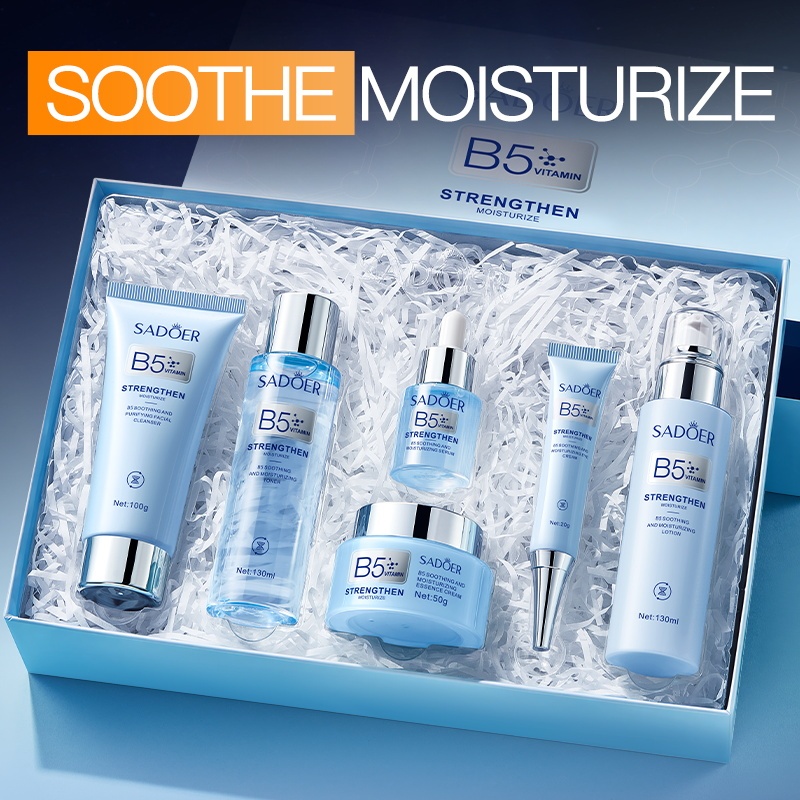
One nuance deserves a line in the specification: panthenol does not preserve anything, and at higher levels it raises the nutrient load of the water phase. A high-panthenol formula needs its own preservative challenge test, because data from a lower-loading version does not carry over. A reference set is the vitamin B5 skincare set and the eye patch format in the current range.
4. The viscosity effect brands underestimate
Above roughly 2%, panthenol thickens the water phase noticeably, and the stringiness increases when combined with carbomer-type thickeners. In a cream that reads as richness and helps the texture story. In an essence water or a facial mist it reads as tackiness and degrades the spray pattern. Every panthenol addition needs the thickening system recalibrated, and mist formats should cap the level conservatively.
A practical method is a three-point comparison at 0%, 2% and 4% during the pilot stage, measuring viscosity and panel feel side by side. Setting the final level from a texture ladder, rather than from a competitor label, prevents most of the after-feel complaints in this category.
5. Stability, claims and release control
Panthenol is chemically stable under normal cosmetic conditions, with slow hydrolysis only under prolonged strong acid, strong base or heat, so routine stability testing is sufficient. On claims, phrases such as "contains panthenol", "moisturising and soothing" and "supports the skin barrier" are the defensible core; any concentration statement refers to the formula level, not to skin delivery. Panthenol persuades as part of a designed system, not as a headline active, and the claim file should reflect that framing.
For buyers, the useful questions are straightforward: which grade is quoted, what level is targeted, and whether the preservative challenge was run at that level. The broader range sits under our product range, line capability is described on the workshop page, and samples can be arranged through the inquiry form.
Frequently asked questions
Can you produce Panthenol and Vitamin B5 in Private Label Skincare under our own brand?
Panthenol and Vitamin B5 in Private Label Skincare is handled as a private label project: you bring the brand and the market position, we cover formula, bulk, filling and packing. Existing bases can be adjusted for texture, fragrance and active level, or we develop from a new brief. Tooling and artwork belong to you, and our name does not appear on the pack.
What is the minimum order quantity?
MOQ is set by net fill per unit: under 15 ml/g 5,000 pcs; 15-50 ml/g 3,000 pcs; 50-200 ml/g 2,000 pcs; above 200 ml/g 1,000 pcs. Several SKUs in one project can share a production run to reach the threshold.
How long do samples and bulk production take?
Samples take 7-10 working days from a confirmed brief, or 10-15 days when a new mould or artwork is involved. Bulk runs 25-35 days after sample approval and packaging arrival. Repeat orders with an unchanged formula usually move faster.
Which certificates and documents come with the shipment?
The plant runs under GMPC and ISO 22716 with a 100,000-class cleanroom. Each shipment can include COA, MSDS, the full INCI list, stability data and microbiological reports. For the EU we support CPSR and PIF paperwork; for other markets we prepare the file set your importer asks for.
Can we change the formula, fragrance or packaging?
Yes. Texture, viscosity, fragrance, colour and active percentage are adjustable within regulatory limits. Packaging can be sourced by you or by us: tubes, airless bottles, jars, sachets and aluminium foil bags, with silkscreen, hot stamping or label application.
What information do you need to quote?
Category and target function, quantity per SKU, packaging direction, destination market and launch date. With that we reply within 24 hours on business days with feasibility, MOQ and a price range. An NDA can be signed before formulas are discussed.
Need this produced? Talk to the factory.
Wangsha Bio has run OEM/ODM production since 2006: 60,000 sqm plant, 17 lines, 100,000-class cleanroom, GMPC and ISO 22716 certified. Send your brief and we reply within 24 hours on business days with feasibility, MOQ and a price range.
Email lucky@moksha-bio.com | Product range | Workshop
