
 Qingyuan moksha Biotechnology Co., Ltd


Some products deliberately refuse to mix. They sit on the shelf as two clean layers, the user shakes the bottle, and for a few minutes the contents behave as a temporary emulsion. The format is common in eye makeup removers and in oil-serum hybrids, and it communicates a water-and-oil promise without a word of copy. The technical difficulty is not creating the layers, it is making those first few minutes pleasant and keeping the interface clean for two years. This guide covers formulation, filling and verification.
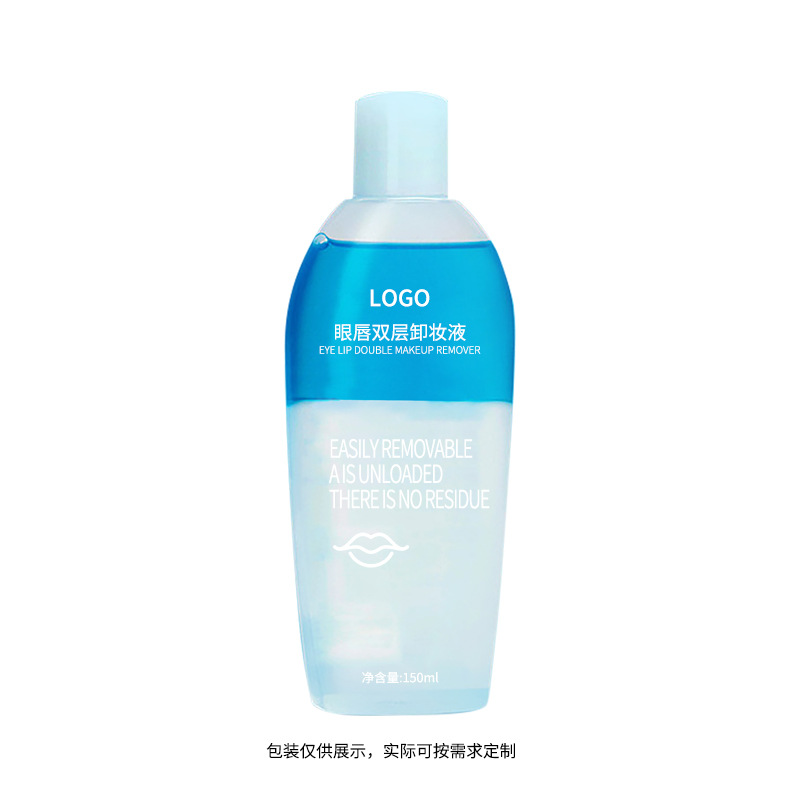
Why the Format Works Commercially
A bi-phase product separates two immiscible phases and reunites them through mechanical energy at the moment of use. The benefit is direct: water-phase freshness and oil-phase richness without any emulsifier, which keeps the ingredient list unusually short. A short list is easy to talk about, but it also leaves very few levers to adjust.
The cost is that performance depends entirely on what the user does. Shake too little and the poured ratio is wrong; leave it standing after shaking and it separates again. How the user shakes has to be treated as a process parameter, not as an instruction printed in small type. An existing format is this double layer eye and lip remover.
Density and Interface Design
Oil on top and water below is the arrangement shoppers expect. It requires the oil phase to be less dense than the water phase, which most vegetable oils satisfy naturally, though adding silicones or esters can change the balance. A density difference that is too small separates slowly, one that is too large separates before the user finishes applying, and both generate complaints.
Interfacial tension controls how finely the phases disperse on shaking and how long the dispersion lasts. Lowering it moderately gives a finer, longer-lasting temporary emulsion; lowering it too far delays separation and destroys the visual that the product is sold on. The target is easy to shake up and quick to separate, not maximum stability.
Salts and polyols in the water phase
Adding salt or a high polyol level widens the density gap and suppresses microbial growth at the same time, but both change skin feel: salt reads as tightness, polyols as tackiness. The water phase has to satisfy density, preservation and sensory constraints simultaneously, and the available space is narrower than it looks. A water-and-oil serum using the same principle is this water light activating essence oil.
Filling: Sequence and Ratio Accuracy
Two phases mean two filling passes, usually water first and oil second, with a settling interval between them so the interface can level. Ratio accuracy decides the experience directly: too much oil feels greasy, too little removes makeup poorly. Tolerance for a bi-phase product should be tighter than for a single-phase one, because the error concentrates visibly in the interface height.
The filler needs two independent circuits and a thorough clean between batches, since residue alters interfacial behaviour. Vigorous handling after filling leaves the interface cloudy for hours, which reads as a defect at release inspection. Allowing a settling period after filling is the simplest step and the one most often skipped. Filling conditions are described in the workshop overview.
What Stability Testing Should Look At
The observation list differs from an emulsion: interface clarity, drift in interface height, colour transfer between phases, and consistency of the dispersion after shaking. Interface drift usually means one phase is slowly migrating, and it is an early signal of a formulation problem rather than a filling problem.
Temperature cycling matters more here than constant storage. A water phase that freezes and thaws takes time to reform a clean interface, and heat accelerates mutual dissolution of the two phases until the boundary blurs. Enough cycles expose more than months of steady storage. A bi-phase serum carrying actives also needs an assay of each active in its own phase.
Instructions and Claim Boundaries
Usage instructions carry more weight in this format than in most. They should state how many shakes are needed, whether the bottle should rest before pouring, and whether the neck needs wiping. Clear instructions measurably reduce reviews that say the product did nothing.
Claims can describe the sensory layering that water and oil produce, but should not extend the idea into a promise about skin structure. Appearance language is safe; physiological language is not. Specifications can be submitted through the inquiry form, and manufacturer credentials appear on the about us page.
Bi-phase looks simple and is decided entirely by detail. Fix the density gap, tune the interface for shake-up and separation, hold the filling ratio, and write instructions a user will actually follow.
Frequently asked questions
Can you produce Bi-Phase and Shake-Before-Use Formats under our own brand?
Bi-Phase and Shake-Before-Use Formats is handled as a private label project: you bring the brand and the market position, we cover formula, bulk, filling and packing. Existing bases can be adjusted for texture, fragrance and active level, or we develop from a new brief. Tooling and artwork belong to you, and our name does not appear on the pack.
What is the minimum order quantity?
MOQ is set by net fill per unit: under 15 ml/g 5,000 pcs; 15-50 ml/g 3,000 pcs; 50-200 ml/g 2,000 pcs; above 200 ml/g 1,000 pcs. Several SKUs in one project can share a production run to reach the threshold.
How long do samples and bulk production take?
Samples take 7-10 working days from a confirmed brief, or 10-15 days when a new mould or artwork is involved. Bulk runs 25-35 days after sample approval and packaging arrival. Repeat orders with an unchanged formula usually move faster.
Which certificates and documents come with the shipment?
The plant runs under GMPC and ISO 22716 with a 100,000-class cleanroom. Each shipment can include COA, MSDS, the full INCI list, stability data and microbiological reports. For the EU we support CPSR and PIF paperwork; for other markets we prepare the file set your importer asks for.
Can we change the formula, fragrance or packaging?
Yes. Texture, viscosity, fragrance, colour and active percentage are adjustable within regulatory limits. Packaging can be sourced by you or by us: tubes, airless bottles, jars, sachets and aluminium foil bags, with silkscreen, hot stamping or label application.
What information do you need to quote?
Category and target function, quantity per SKU, packaging direction, destination market and launch date. With that we reply within 24 hours on business days with feasibility, MOQ and a price range. An NDA can be signed before formulas are discussed.
Need this produced? Talk to the factory.
Wangsha Bio has run OEM/ODM production since 2006: 60,000 sqm plant, 17 lines, 100,000-class cleanroom, GMPC and ISO 22716 certified. Send your brief and we reply within 24 hours on business days with feasibility, MOQ and a price range.
Email lucky@moksha-bio.com | Product range | Workshop
