Qingyuan moksha Biotechnology Co., Ltd


Hydrogel eye patches have become a fixture in under-eye care ranges because they combine a visible format with a low barrier to trial. They are also one of the harder formats to specify well: the patch has to hold its shape, stay where it is put on a curved surface, and release serum at a sensible rate. Most complaints about eye patches trace back to the gel network, not to the active ingredients.
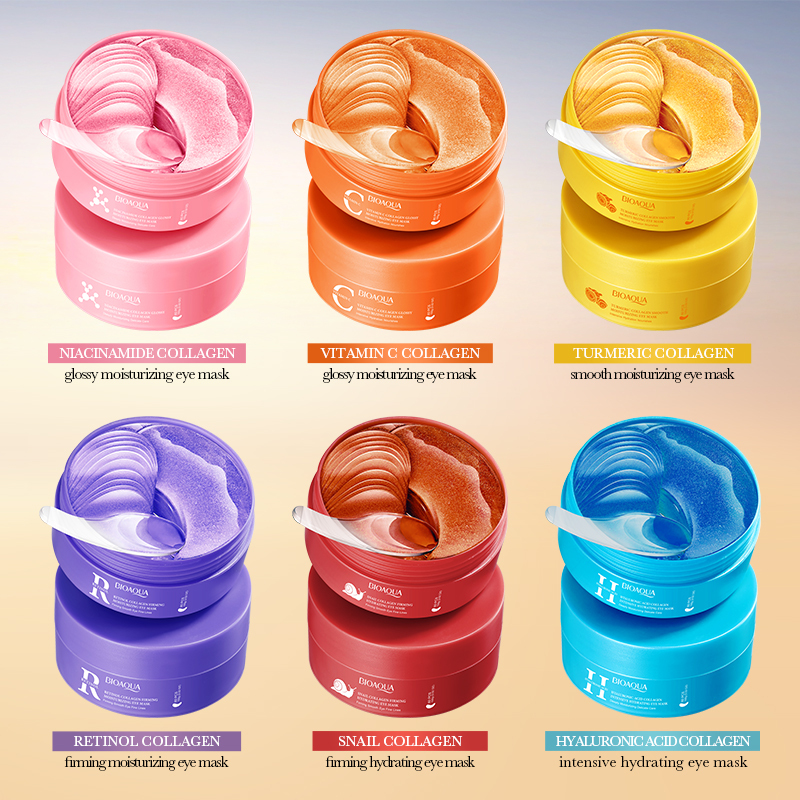
Gel Systems and the Feel They Produce
Most hydrogel patches are built on carrageenan, agar, gellan or a blend, sometimes with a polyacrylic thickener for body. Carrageenan gives a springy, slightly translucent gel; agar gives a firmer bite that holds shape in a jar; gellan allows a cleaner cut and better clarity. The choice of gelling system sets texture, drape and cost before any active is considered.
Glycerin and humectants act as plasticisers as well as moisturisers. Too little and the patch turns brittle in the sachet; too much and it weeps. Plasticiser level should be fixed against the intended storage temperature, not the bench. A cooling grape seed collagen patch, for example, needs a firmer network than a foil-backed format because the whole patch is handled.
Adhesion on a Curved Surface
Adhesion is where bench samples usually fail in use. The under-eye area curves in two directions, and a patch cut flat will lift at the outer corner. Die geometry matters as much as gel tack when patches lift. A slight taper and a rounded outer edge hold far better than a plain oval.
Surface moisture also drives adhesion. Skin that is too wet makes the patch slide; skin that is too dry makes it peel within minutes. Instructions that tell the user to apply on clean, lightly dried skin solve more complaints than a formulation change. Thickness is the third lever: a 1.2 mm patch conforms better than a 2 mm one, but holds less serum.
Serum Load and Release
Serum load is quoted as grams per patch, and it is easy to overstate. Above the network's holding capacity the excess sits on the surface, makes the patch slippery and pools in the sachet. Load should be set just under the point where free liquid appears. A simple press test on blotting paper shows the threshold quickly.
Release over the wear window matters more than the headline number. Patches that give up their liquid in the first five minutes feel wet then dry out; a slower release keeps the surface comfortable for the full twenty minutes. Measure residual serum after a fixed wear time rather than trusting the fill figure. Film formers and small amounts of oil phase are the usual levers.
Sachet Filling and Seal Integrity
Sachets are filled with the patch plus a small volume of serum, then sealed. Fill accuracy has to account for the patch itself, so the target is set on total weight with a tolerance band. Weigh the whole sachet, not the liquid, because the patch carries most of the mass. A check weigher on the line catches the outliers that manual sampling misses.
Seal integrity decides shelf life. Residual product in the seal zone is the usual cause of leakers, and it becomes more likely as fill speed rises. Seal parameters should be validated at the line speed actually used in production, not at half speed. Vacuum leak testing on a sample per batch is a cheap control.
Claims and Pack Design
Under-eye claims drift towards puffiness and dark circles, which sit close to the line between appearance and medical effect. Wording should stay with how the area looks and feels. Keep claims on appearance and sensation, and hold the evidence to match. Cooling sensation, hydration and the look of tiredness are defensible; anything stronger needs substantiation.
Pack design drives perceived value here. A jar signals a spa routine and allows the user to see the patches; a single sachet pair signals hygiene and travel. Choose the pack against how the product will be used, not against how it will photograph. Comparable patch formats are listed in the product range, production conditions in the workshop overview, and sampling starts from the contact page.
Frequently asked questions
Can you produce Hydrogel Eye Patches under our own brand?
Hydrogel Eye Patches is handled as a private label project: you bring the brand and the market position, we cover formula, bulk, filling and packing. Existing bases can be adjusted for texture, fragrance and active level, or we develop from a new brief. Tooling and artwork belong to you, and our name does not appear on the pack.
What is the minimum order quantity?
MOQ is set by net fill per unit: under 15 ml/g 5,000 pcs; 15-50 ml/g 3,000 pcs; 50-200 ml/g 2,000 pcs; above 200 ml/g 1,000 pcs. Several SKUs in one project can share a production run to reach the threshold.
How long do samples and bulk production take?
Samples take 7-10 working days from a confirmed brief, or 10-15 days when a new mould or artwork is involved. Bulk runs 25-35 days after sample approval and packaging arrival. Repeat orders with an unchanged formula usually move faster.
Which certificates and documents come with the shipment?
The plant runs under GMPC and ISO 22716 with a 100,000-class cleanroom. Each shipment can include COA, MSDS, the full INCI list, stability data and microbiological reports. For the EU we support CPSR and PIF paperwork; for other markets we prepare the file set your importer asks for.
Can we change the formula, fragrance or packaging?
Yes. Texture, viscosity, fragrance, colour and active percentage are adjustable within regulatory limits. Packaging can be sourced by you or by us: tubes, airless bottles, jars, sachets and aluminium foil bags, with silkscreen, hot stamping or label application.
What information do you need to quote?
Category and target function, quantity per SKU, packaging direction, destination market and launch date. With that we reply within 24 hours on business days with feasibility, MOQ and a price range. An NDA can be signed before formulas are discussed.
Need this produced? Talk to the factory.
Wangsha Bio has run OEM/ODM production since 2006: 60,000 sqm plant, 17 lines, 100,000-class cleanroom, GMPC and ISO 22716 certified. Send your brief and we reply within 24 hours on business days with feasibility, MOQ and a price range.
Email lucky@moksha-bio.com | Product range | Workshop