
 Qingyuan moksha Biotechnology Co., Ltd


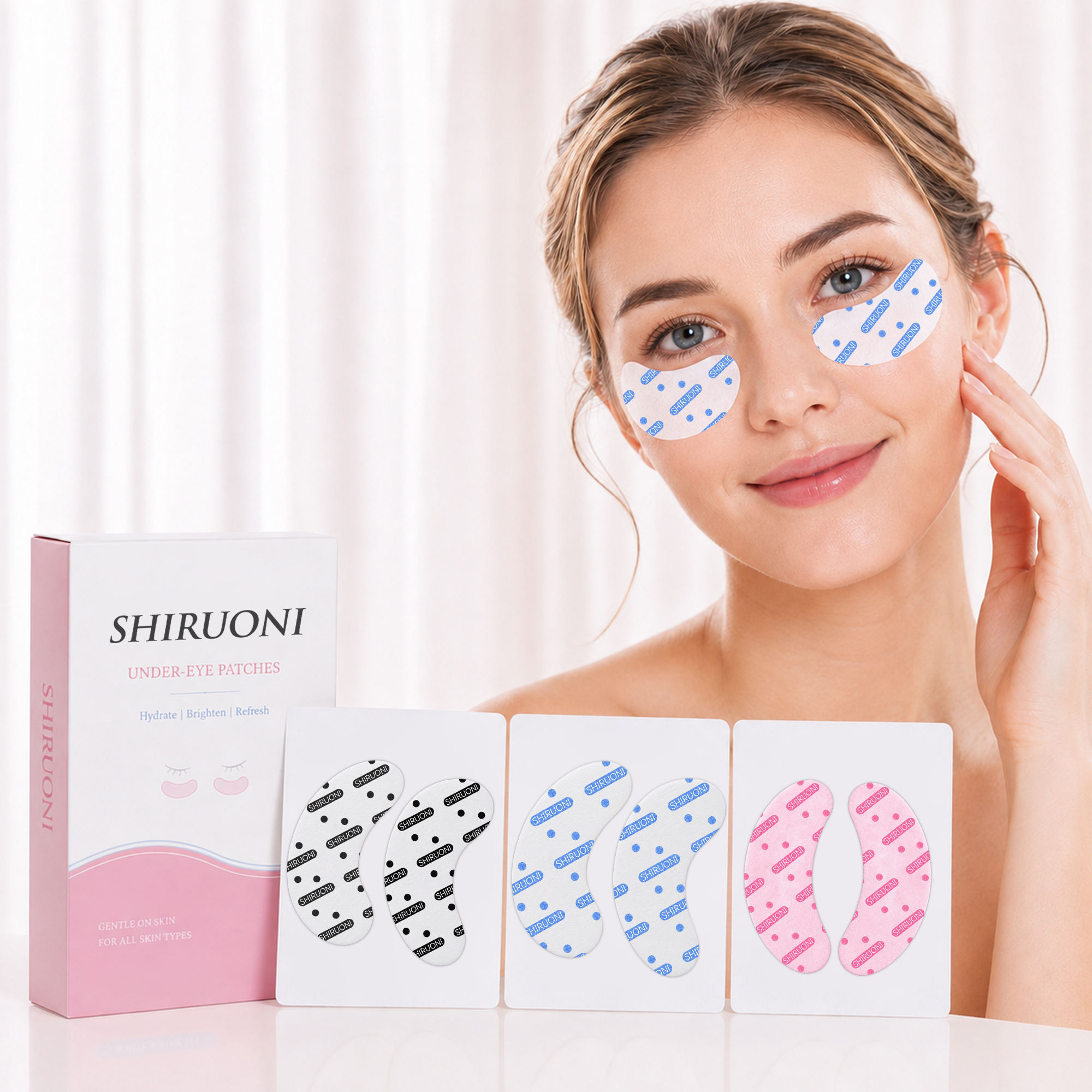
Under eye patches look deceptively simple. They are small, cheap to ship and easy to photograph, which makes them a favourite first private label project for new beauty brands. In practice they are one of the harder categories to manufacture consistently, because their performance depends on a substrate, a serum and a die-cutting process all behaving well together. If you are sourcing private label eye patches for the first time, this guide walks through the decisions that actually determine whether your product launches cleanly.
1. Start with the substrate, not the serum
Most under eye patches fall into one of three substrate families:
Hydrogel patches are cast from a water-based gel. They hold a large volume of serum, cling well to the curved under-eye area and deliver a strong cold, soothing sensation. They are the most popular format for brightening and de-puffing claims.
Collagen patches use a protein-based film. They feel firmer and more substantial on the skin, and the word collagen on the front of the pack still carries strong consumer recognition in Asia and North America.
Non-woven and biocellulose patches are the closest relatives of a sheet mask. They are cheaper per unit but hold less serum and can be harder to keep in place on oily skin.
Before discussing actives, decide which of these three your brand story needs. A supplier that only offers one format will happily sell you that format regardless of fit. A supplier with several platforms will tell you which one suits your claim and your price point.
2. Ask what happens to the actives during casting
This is where many projects quietly fail. Hydrogel substrates are usually produced at elevated temperature, and heat-sensitive actives such as vitamin C, certain peptides and probiotics can lose a meaningful share of their activity during casting. Ask your manufacturer two direct questions:
First, is the active added to the gel matrix or dosed into a separate serum step? Adding actives after the substrate has set preserves far more activity, and it is the standard approach for delicate ingredients. A formula such as PDRN and NAD under eye patches only delivers on its label claim if the actives survive manufacturing intact.
Second, what stability data exists? Accelerated ageing results at 40 degrees Celsius for three months tell you far more than a single lab sample. Ask to see the report, not just the claim.
3. Verify the filling and die-cutting accuracy
Two quality metrics separate good patch factories from average ones. The first is serum fill weight consistency; variation between pouches is what produces the customer reviews complaining that one pack was dry and the next was soaking. The second is patch contour accuracy. A cutter that is slightly out of tolerance produces patches that crease, slip or fail to cover the orbital bone.
Both are process capabilities rather than ingredient claims, so they cannot be verified from a sample alone. This is the moment to look at the production floor. Our own production workshop runs a 60,000 square metre base with Class 100,000 clean rooms, 17 intelligent production lines and dual GMPC and ISO 22716 certification, which is the level of environment a patch project should be produced in.
4. Confirm the documents your market will require
Under eye patches sit close to the eye, so regulators treat them seriously. Depending on your destination market you may need cosmetic product notification, a safety assessment, heavy metal and microbial test reports, and ingredient disclosure against the local restricted list. Ask which documents the factory issues as standard and which are chargeable.
Also confirm who owns the formula. A private label contract should make clear that your formulation, your artwork and your moulds remain yours. Some factories reuse a base formula across clients with only fragrance changes, which can leave two brands selling the same product.
5. Agree MOQ and lead time in writing
Patch minimums are usually driven by the pouching line rather than the gel batch, so MOQ can often be lower than brands expect. Get three numbers in writing before deposit: MOQ per SKU, lead time for the first production run, and lead time for repeat orders. First runs are always slower because of artwork approval and stability testing.
6. Test the supplier with a small order first
Finally, resist the urge to launch six SKUs at once. Place one SKU, in one pack format, and evaluate the whole experience, from how quickly sample revisions arrive to whether the pouches arrive sealed and undamaged. A supplier that communicates well on a small order is a supplier you can scale with.
If you would like to discuss a patch project, our team can advise on substrate selection, active loading and packaging. Browse the wider product range, review our company profile, or send your brief through the inquiry form and we will come back with a quotation.
Frequently asked questions
Can you produce How to Choose a Private Label Manufacturer for Under Eye Patches under our own brand?
How to Choose a Private Label Manufacturer for Under Eye Patches is handled as a private label project: you bring the brand and the market position, we cover formula, bulk, filling and packing. Existing bases can be adjusted for texture, fragrance and active level, or we develop from a new brief. Tooling and artwork belong to you, and our name does not appear on the pack.
What is the minimum order quantity?
MOQ is set by net fill per unit, not by category:
| Net fill | MOQ |
|---|---|
| < 15 ml/g | 5,000 pcs |
| 15-50 ml/g (50 included) | 3,000 pcs |
| 50-200 ml/g (200 included) | 2,000 pcs |
| > 200 ml/g | 1,000 pcs |
Several SKUs in one project can share a production run to reach the threshold, and a smaller trial order is possible once the formula is approved.
How long do samples and bulk production take?
Samples take 7-10 working days from a confirmed brief, or 10-15 days when a new mould or artwork is involved. Bulk runs 25-35 days after sample approval and packaging arrival. Repeat orders with an unchanged formula usually move faster.
Which certificates and documents come with the shipment?
The plant runs under GMPC and ISO 22716 with a 100,000-class cleanroom. Each shipment can include COA, MSDS, the full INCI list, stability data and microbiological reports. For the EU we support CPSR and PIF paperwork; for other markets we prepare the file set your importer asks for.
Can we change the formula, fragrance or packaging?
Yes. Texture, viscosity, fragrance, colour and active percentage are adjustable within regulatory limits. Packaging can be sourced by you or by us: tubes, airless bottles, jars, sachets and aluminium foil bags, with silkscreen, hot stamping or label application.
What information do you need to quote?
Category and target function, quantity per SKU, packaging direction, destination market and launch date. With that we reply within 24 hours on business days with feasibility, MOQ and a price range. An NDA can be signed before formulas are discussed.
Need this produced? Talk to the factory.
Wangsha Bio has run OEM/ODM production since 2006: 60,000 sqm plant, 17 lines, 100,000-class cleanroom, GMPC and ISO 22716 certified. Send your brief and we reply within 24 hours on business days with feasibility, MOQ and a price range.
Email lucky@moksha-bio.com | Product range | Workshop
