
 Qingyuan moksha Biotechnology Co., Ltd


Clay masks are one of the few product forms where the consumer can see the mechanism working: the paste dries, tightens and is rinsed away. That visibility makes the format attractive and unforgiving, because a mask that dries too fast, cracks or leaves the skin taut will not be repurchased. In a clay mask, the drying profile is the product. This guide covers clay selection, base design, drying behaviour and claim limits.
Choosing the Clay
Clays differ in particle size, cation exchange capacity and pH, and those differences drive the sensory result. Kaolin gives a comparatively gentle, soft paste; bentonite swells strongly and delivers more viscosity per unit; illite and montmorillonite sit between the two in behaviour. Pick the clay for the drying profile the brief calls for, not for the name on the ingredient list.
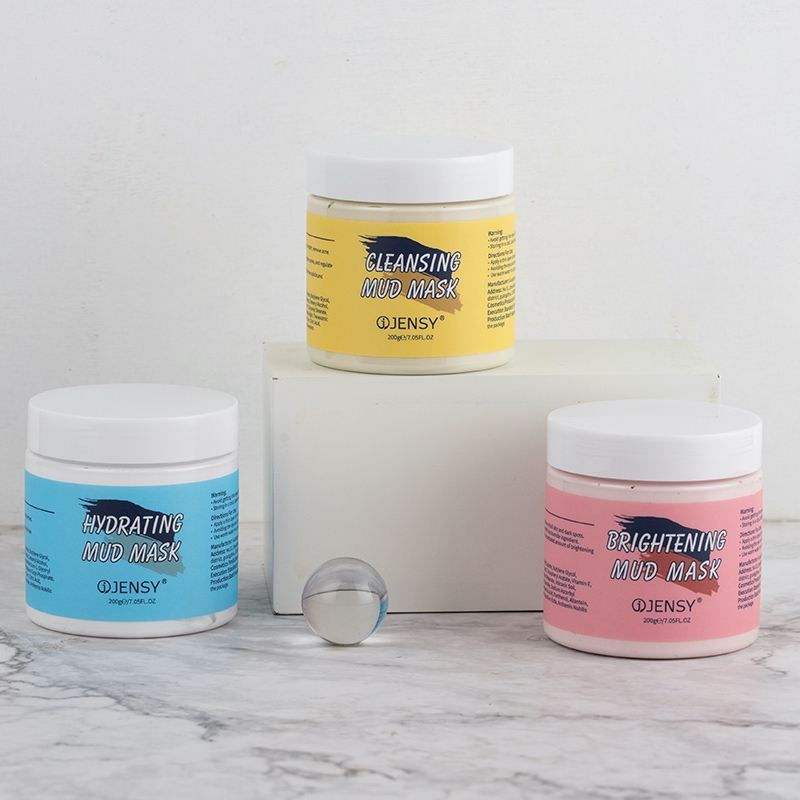
Particle size affects both feel and drying speed, because finer fractions pack more densely and release water differently. Sourcing should specify a particle size range rather than a mean. A size range, not an average, is what makes a clay lot repeatable. Formats in the current range include this mud mask reference, and the wider product range covers the related categories.
Building the Base Around the Clay
A clay paste is a suspension as much as a cream, so the base has to hold the solids in place while staying spreadable. Humectants slow drying, oils soften the dry-down, and thickeners control paste body. Every humectant added changes the drying time, so the base and the clay load have to be tuned together.
Water activity and microbiological load are the second consideration, because a clay paste contains suspended solids, water and often botanical extracts. Preservation in a solids-loaded paste is harder than in a clear gel, and the challenge test has to run on the finished paste in its final pack.
Why the paste cannot be judged from the vessel
The paste in a bulk vessel is not the paste the user applies. It thickens as it stands, and the true consistency only appears after filling and a short rest. Sensory panels should work from filled units that have settled rather than from freshly produced bulk.
Drying Behaviour and the Tightness Question
Drying speed is controlled by humectant level, oil content, paste thickness and the film weight the user applies. A user who applies twice the intended amount will experience a slower dry but a stronger tightening sensation. Drying time has to be specified together with an assumed application weight, or the target is not measurable.
Tightness is the sensation most closely linked to repurchase in this format and the easiest to overshoot. A mask that leaves the face uncomfortable after ten minutes loses the customer regardless of how it performed during the first five. Tune the dry-down so the tightening peaks and then eases, rather than continuing to build.
Suspension, Filling and Net Weight
Clays settle. The paste has to be formulated with enough yield stress to hold solids through shelf life, and the filling head has to dispense an even solids load per unit. Net weight variation in a clay paste is a solids distribution problem before it is a filling problem.
Stability work should record settling, water separation at the surface and any hardening in the pack. A paste that becomes difficult to dispense after three months is a commercial failure even if it passes every chemical test. Dispensing force at the end of shelf life belongs in the specification. Production and filling conditions are described in the workshop overview.
Claims and the Application Instruction
Clay mask claims drift toward absorbing, purifying and balancing language, and some wording moves closer to a physiological effect than the evidence supports. Wording should stay with what the user sees and feels. Rewrite any claim that describes what the skin does rather than what the product does.
Application instructions carry commercial weight in this format: recommended film thickness, leave-on time and removal method each change the experience substantially. A clearly specified application routine is part of the product specification, not an afterthought on the carton. Requirements can be submitted through the inquiry form.
Clay masks sell on a visible effect in ten minutes, so the drying profile has to be deliberately designed. Choose the clay for its behaviour, tune the base to the dry-down, prove the suspension and control the claims: done in that order, the format performs reliably.
Frequently asked questions
Can you produce Clay and Mud Masks under our own brand?
Clay and Mud Masks is handled as a private label project: you bring the brand and the market position, we cover formula, bulk, filling and packing. Existing bases can be adjusted for texture, fragrance and active level, or we develop from a new brief. Tooling and artwork belong to you, and our name does not appear on the pack.
What is the minimum order quantity?
MOQ is set by net fill per unit, not by category:
| Net fill | MOQ |
|---|---|
| < 15 ml/g | 5,000 pcs |
| 15-50 ml/g (50 included) | 3,000 pcs |
| 50-200 ml/g (200 included) | 2,000 pcs |
| > 200 ml/g | 1,000 pcs |
Several SKUs in one project can share a production run to reach the threshold, and a smaller trial order is possible once the formula is approved.
How long do samples and bulk production take?
Samples take 7-10 working days from a confirmed brief, or 10-15 days when a new mould or artwork is involved. Bulk runs 25-35 days after sample approval and packaging arrival. Repeat orders with an unchanged formula usually move faster.
Which certificates and documents come with the shipment?
The plant runs under GMPC and ISO 22716 with a 100,000-class cleanroom. Each shipment can include COA, MSDS, the full INCI list, stability data and microbiological reports. For the EU we support CPSR and PIF paperwork; for other markets we prepare the file set your importer asks for.
Can we change the formula, fragrance or packaging?
Yes. Texture, viscosity, fragrance, colour and active percentage are adjustable within regulatory limits. Packaging can be sourced by you or by us: tubes, airless bottles, jars, sachets and aluminium foil bags, with silkscreen, hot stamping or label application.
What information do you need to quote?
Category and target function, quantity per SKU, packaging direction, destination market and launch date. With that we reply within 24 hours on business days with feasibility, MOQ and a price range. An NDA can be signed before formulas are discussed.
Need this produced? Talk to the factory.
Wangsha Bio has run OEM/ODM production since 2006: 60,000 sqm plant, 17 lines, 100,000-class cleanroom, GMPC and ISO 22716 certified. Send your brief and we reply within 24 hours on business days with feasibility, MOQ and a price range.
Email lucky@moksha-bio.com | Product range | Workshop
