Qingyuan moksha Biotechnology Co., Ltd


Recombinant collagen has moved from a novelty claim to a standard option in mid-range and premium skincare ranges. It is produced by microbial expression rather than extracted from animal tissue, which gives a tighter molecular weight distribution, better solubility control and far more consistent batches. Whether recombinant collagen can be built into a product depends on the material form and the base it goes into, not on the story behind it. This guide covers material selection, dosage, compatibility and the validation steps worth scheduling early.
How Recombinant Collagen Differs from Animal-Derived Material
Animal-derived collagen varies with the tissue source and the season, so molecular weight distribution, colour and odour can shift from lot to lot. Recombinant material is produced in a controlled expression system, which makes the specification far more repeatable. Batch consistency is the most practical advantage recombinant collagen brings at production scale.
The difference also changes what the formula has to handle. Recombinant collagen is a water-soluble protein, sensitive to temperature, pH and the preservation system, so the maximum process temperature has to appear in the batch record rather than only on the formula sheet. Writing the process condition into the manufacturing record is what carries the material advantage into the finished product.
Material Forms and Molecular Weight
Suppliers offer recombinant collagen as a liquid concentrate, as a powder, and as pre-blended compounds. Liquid forms shorten the batching stage but need temperature control and preservation attention in storage. Powder forms are more stable and cheaper to ship, but the dissolution step has to be controlled or the material clumps or fails to dissolve completely. Pre-blended compounds combine collagen with humectants and suit projects with a short development window. The form should be chosen against production capability and product format, not against the price per kilogram.
What molecular weight does to the feel
Higher molecular weight fractions form a more noticeable film on the surface, which suits richness and immediate skin feel. Lower molecular weight fractions spread more lightly and feel more absorbed, but they need a fuller humectant and soothing system around them. Combining both fractions is the usual route to a product that feels substantial and still disappears quickly.
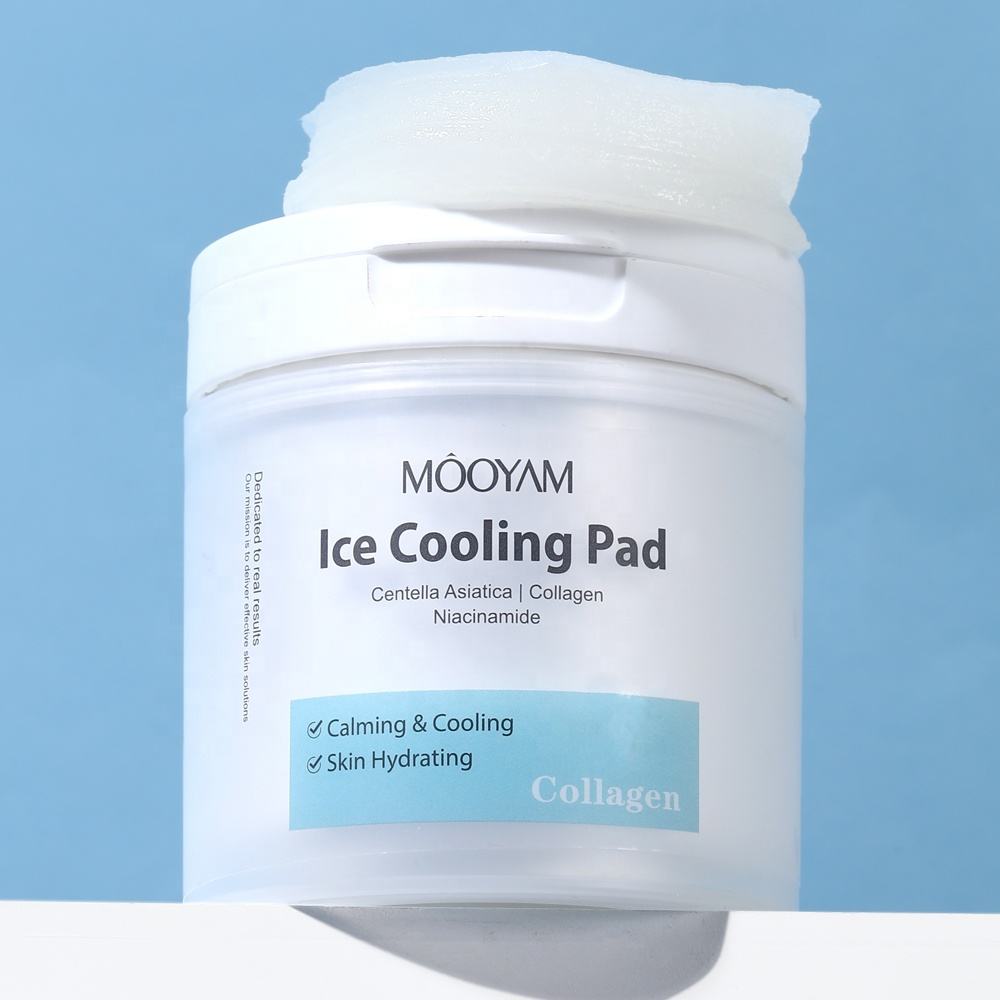
An existing water-based serum skeleton for this direction is shown in this collagen and niacinamide reference, and a pad format carrying collagen is listed as collagen ice facial pads.
Dosage Ranges and Compatibility Questions
Dosage is limited by solubility, viscosity shift and the odour that protein materials carry. Above a certain level, some bases thin out noticeably or develop an odour that the fragrance system then has to mask. Set the dose at the highest level the base carries well rather than at the highest number that reads impressively on a label.
Three compatibility questions deserve attention before sampling. First, interaction with the preservation system, since protein materials can be affected by certain preservative chemistries and the challenge test then has to be repeated. Second, electrolyte and thickener tolerance, because salts can thin the base. Third, behaviour alongside chelating agents and other actives. Settling these three questions early is cheaper than discovering them after a stability run.
Different Formats, Different Approaches
In a sheet mask the carrier is the essence, so the practical variable is viscosity and loading capacity; a thin essence holds less liquid in the substrate and needs a thickener system to compensate. A serum is judged on lightness, which usually means a lower dose supported by several humectants. The same raw material behaves differently in each format, so a formula cannot simply be transferred between them.
Wash-off formats work on another principle entirely. In a shampoo or body wash the material operates inside a surfactant system, where it plays a conditioning rather than a skin-care role. Check its stability across the neutral to mildly acidic range and its compatibility with cationic conditioning components. Reference wash-off formats include this amino acid shampoo and the wider product range.
Validation and Claims
Run stability work in the final pack across three temperature conditions and add a light exposure condition, because protein materials are light-sensitive. Beyond appearance and odour, record active content and pH at every checkpoint. Data from the first and last checkpoints alone say nothing about what happens in between.
Claims can describe softness and firmness as perceived qualities, but should stay away from any phrasing that implies a physiological effect, and should avoid absolute wording. Every claim should map to a raw material basis or a test result. Manufacturing conditions are summarised in the workshop overview, and manufacturer credentials are available on request.
Recombinant collagen rewards discipline rather than enthusiasm. Choose the form for the format, hold the dose inside what the base can carry, verify compatibility early and test to the end of shelf life. Do those four things and the ingredient performs as the label promises. Submit project requirements through the inquiry form to begin sampling.
Frequently asked questions
Can you produce Recombinant Collagen in Private Label Skincare under our own brand?
Recombinant Collagen in Private Label Skincare is handled as a private label project: you bring the brand and the market position, we cover formula, bulk, filling and packing. Existing bases can be adjusted for texture, fragrance and active level, or we develop from a new brief. Tooling and artwork belong to you, and our name does not appear on the pack.
What is the minimum order quantity?
MOQ is set by net fill per unit, not by category:
| Net fill | MOQ |
|---|---|
| < 15 ml/g | 5,000 pcs |
| 15-50 ml/g (50 included) | 3,000 pcs |
| 50-200 ml/g (200 included) | 2,000 pcs |
| > 200 ml/g | 1,000 pcs |
Several SKUs in one project can share a production run to reach the threshold, and a smaller trial order is possible once the formula is approved.
How long do samples and bulk production take?
Samples take 7-10 working days from a confirmed brief, or 10-15 days when a new mould or artwork is involved. Bulk runs 25-35 days after sample approval and packaging arrival. Repeat orders with an unchanged formula usually move faster.
Which certificates and documents come with the shipment?
The plant runs under GMPC and ISO 22716 with a 100,000-class cleanroom. Each shipment can include COA, MSDS, the full INCI list, stability data and microbiological reports. For the EU we support CPSR and PIF paperwork; for other markets we prepare the file set your importer asks for.
Can we change the formula, fragrance or packaging?
Yes. Texture, viscosity, fragrance, colour and active percentage are adjustable within regulatory limits. Packaging can be sourced by you or by us: tubes, airless bottles, jars, sachets and aluminium foil bags, with silkscreen, hot stamping or label application.
What information do you need to quote?
Category and target function, quantity per SKU, packaging direction, destination market and launch date. With that we reply within 24 hours on business days with feasibility, MOQ and a price range. An NDA can be signed before formulas are discussed.
Need this produced? Talk to the factory.
Wangsha Bio has run OEM/ODM production since 2006: 60,000 sqm plant, 17 lines, 100,000-class cleanroom, GMPC and ISO 22716 certified. Send your brief and we reply within 24 hours on business days with feasibility, MOQ and a price range.
Email lucky@moksha-bio.com | Product range | Workshop