
 Qingyuan moksha Biotechnology Co., Ltd


Children's personal care is a small category with a rulebook far larger than its shelf space. A formula that is unremarkable in an adult line becomes a documentation project once the user is under twelve: the ingredient list narrows, the microbiological limit tightens, the artwork changes and every claim has to be traceable to a file. The hard part of children's cosmetic OEM is not making the product, it is making the record that supports it. Wangsha Bio has produced children's masks and cleansing foams for private label, and this note walks through the four decisions that decide whether a project launches cleanly.
1. Two age bands, two specification sets
Chinese rules split the category at three years of age: infant and toddler products for 0-3, children's products for 3-12. The split is not cosmetic. Infant and children's products sit under two different sets of requirements for permitted claims, restricted ingredients and the depth of the safety assessment, and a brief that never states which band it targets will be rewritten later at cost.
Since May 2022, newly filed children's cosmetics must carry the dedicated children's cosmetic mark on the display panel of the sales pack, and older stock has already passed through its relabelling window. A product that claims to be for children without that mark is the single easiest finding in a market inspection.
The filing file itself is heavier than for adult products: formula, standard, test reports, plus a safety assessment report and a summary of the evidence behind each claim. Exposure is calculated on child physiology rather than adult physiology, and for the infant band the assumptions get more conservative. Copying an adult safety assessment across is the most common reason a children's filing comes back.
2. Surfactant systems for low-irritation cleansing
Cleansers carry most of the formulation risk, because surfactants stay in contact with skin and eyes. The practical route is a backbone of non-ionic glucosides and amphoteric surfactants, with an anionic surfactant present only as a minor component to lift foam and rinse speed. Moving the backbone from anionic to glucoside and amphoteric cuts irritation potential far more than trimming the total active matter.
pH sits between 5.5 and 7.0, close to the surface of children's skin, and viscosity is built with a mild thickener rather than a high-electrolyte system that would push the surfactant out of its comfortable range. The "no tears" story is a consequence of surfactant type, concentration and pH together, not an additive you can dose in at the end.
For leave-on formats such as masks and lotions, the oil phase stays light and the emulsifier level stays one step below an adult equivalent, so the product spreads with little drag. A light oil phase and a reduced emulsifier load do more for comfort than a longer actives list.
3. Preservation, pH and microbiological limits
Children's cosmetics are held to the tighter colony count tier, 500 CFU/g, which is the same tier applied to eye-area and lip products. Reaching it is an environment and packaging question before it is a preservative question. Holding 500 CFU/g comes from filling conditions and container cleanliness, not from raising the preservative level.
Preservative choice therefore stays short and familiar: phenoxyethanol with benzoic or sorbic acid, supported by polyols and a low water activity design. Formaldehyde releasers and methylisothiazolinone are normally left out of the palette altogether, and fragrance and colour are kept to what the brief can justify. Every ingredient you remove from the formula is one less document you have to defend.
Production runs in a dedicated area or behind effective physical segregation, with changeover validation and cleaning records kept on file when lines are shared with adult products. Beyond routine physical and microbiological testing, children's products usually go through skin irritation and repeated insult patch testing, with the infant band on a more cautious protocol. Shared lines are workable, but only when the changeover evidence survives an audit.
4. Claims, artwork and the documents behind them
Claims must match the filing. For the infant band the permitted ground is narrow: cleansing, moisturising, talc-free freshness, nappy care, soothing and sun protection, while whitening, acne, hair removal, colouring, perming and anti-hair-loss claims sit outside the category. A claim that runs one sentence ahead of the file turns into a rework cycle, so it is cheaper to write it accurately the first time.
Artwork adds two constraints that brand teams underestimate: the pack must not imply food or a toy, and the shape must not invite accidental ingestion. Functionally, a pump or a flip-top tube beats a wide-mouth jar, because the buyer is an adult and the user is a child. Children's packaging is reviewed twice over, once for the child using it and once for the parent paying for it.
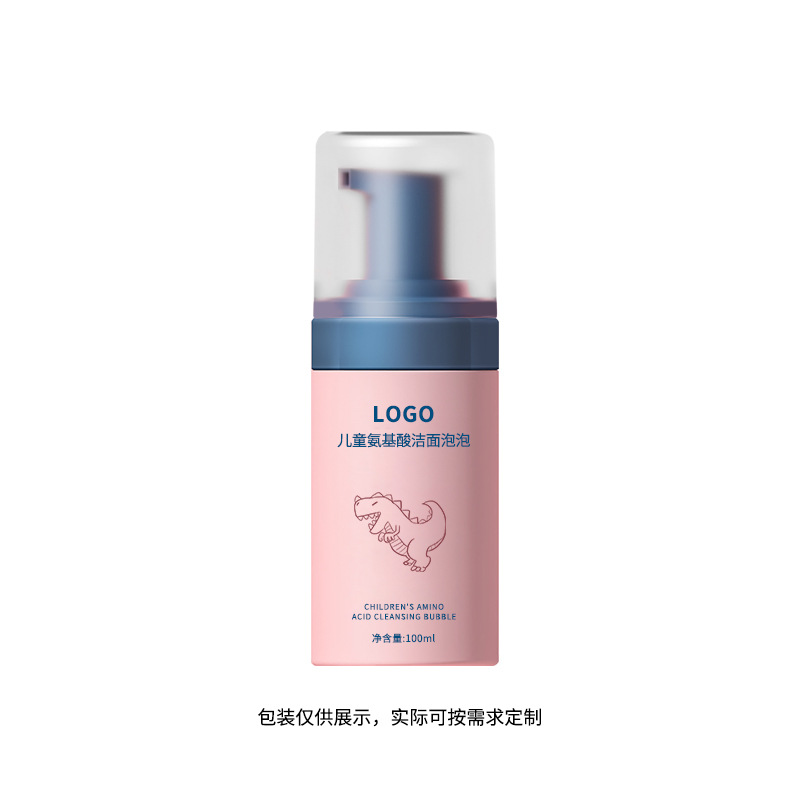
A reference format is the children's amino acid cleansing foam; plant and certification detail sits on the about us page, and briefs can be sent through contact.
Frequently asked questions
Can you produce Children's Cosmetic Products under our own brand?
Children's Cosmetic Products is handled as a private label project: you bring the brand and the market position, we cover formula, bulk, filling and packing. Existing bases can be adjusted for texture, fragrance and active level, or we develop from a new brief. Tooling and artwork belong to you, and our name does not appear on the pack.
What is the minimum order quantity?
MOQ is set by net fill per unit: under 15 ml/g 5,000 pcs; 15-50 ml/g 3,000 pcs; 50-200 ml/g 2,000 pcs; above 200 ml/g 1,000 pcs. Several SKUs in one project can share a production run to reach the threshold.
How long do samples and bulk production take?
Samples take 7-10 working days from a confirmed brief, or 10-15 days when a new mould or artwork is involved. Bulk runs 25-35 days after sample approval and packaging arrival. Repeat orders with an unchanged formula usually move faster.
Which certificates and documents come with the shipment?
The plant runs under GMPC and ISO 22716 with a 100,000-class cleanroom. Each shipment can include COA, MSDS, the full INCI list, stability data and microbiological reports. For the EU we support CPSR and PIF paperwork; for other markets we prepare the file set your importer asks for.
Can we change the formula, fragrance or packaging?
Yes. Texture, viscosity, fragrance, colour and active percentage are adjustable within regulatory limits. Packaging can be sourced by you or by us: tubes, airless bottles, jars, sachets and aluminium foil bags, with silkscreen, hot stamping or label application.
What information do you need to quote?
Category and target function, quantity per SKU, packaging direction, destination market and launch date. With that we reply within 24 hours on business days with feasibility, MOQ and a price range. An NDA can be signed before formulas are discussed.
Need this produced? Talk to the factory.
Wangsha Bio has run OEM/ODM production since 2006: 60,000 sqm plant, 17 lines, 100,000-class cleanroom, GMPC and ISO 22716 certified. Send your brief and we reply within 24 hours on business days with feasibility, MOQ and a price range.
Email lucky@moksha-bio.com | Product range | Workshop
