
 Qingyuan moksha Biotechnology Co., Ltd


Freeze-dried sheet masks have moved from a novelty to a recognised format in the mask aisle, sold on a promise conventional soaked masks struggle to match: minimal water, minimal preservative load and actives that stay fresh until the moment of use. The promise is real, but so is the extra engineering behind it. A freeze-dried mask is a packaging and process product as much as a formula product. This guide explains how the format works and what to confirm before committing a project to it.
Why Freeze-Drying Entered the Mask Aisle
A soaked sheet mask carries its actives in a water-based essence for months before use, and water is where most degradation chemistry happens. Freeze-drying removes the water: the actives and the fabric are dried together and remain dormant until the user adds liquid. Removing water removes the clock that runs down conventional masks.
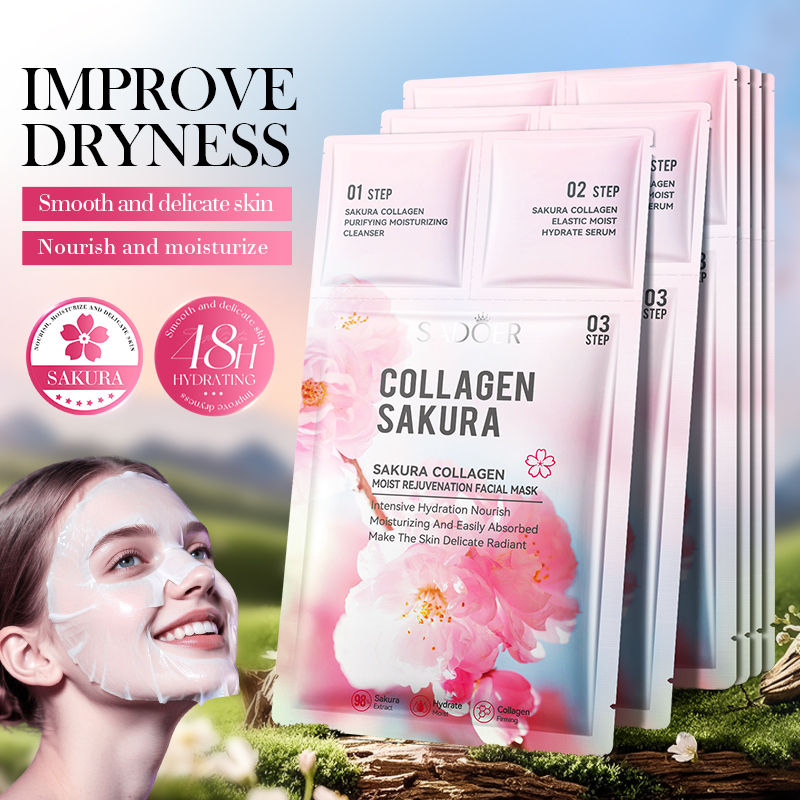
The format also cuts the preservative conversation short, because a dry product is a hostile environment for microbes by design. That advantage supports minimalist positioning, which is currently one of the stronger narratives in the category. Conventional multi-step formats for comparison are listed in the product range, including this three-step mask reference.
How the Format Works in Practice
The user experience has three steps: open the dry mask, add the accompanying ampoule or measured water, wait for the fabric to saturate, then apply. The waiting step is where the format is won or lost. Rehydration speed and evenness decide whether the user perceives innovation or inconvenience.
Well-executed lyophilised masks saturate within a defined window and release their contents uniformly; poorly executed ones leave dry patches, clump or disintegrate. Sampling should therefore score rehydration time, fabric integrity after wetting, and the feel of the mask on skin, using the same panel for every variant. Score the activation step with numbers, because it is the step consumers review online.
Process and Quality Control Points
The freeze-drying cycle is the core process asset: freezing rate, chamber pressure and drying time determine the porosity of the dried structure, and porosity governs how fast liquid penetrates. The lyophilisation curve deserves contract status, because it cannot be reverse-engineered from the finished product.
Quality control adds checks conventional masks never need: residual moisture in the sealed pouch, dry-mask integrity before activation, and microbial limits on the dry product itself. Residual moisture is the single most important release test, because it silently predicts shelf-life failure. Cleanroom and filling conditions are described in the workshop overview.
Fabric choice matters more than usual
Not every sheet fabric survives lyophilisation. The fabric must hold its structure when dry, wet out quickly and release actives rather than binding them. Fabric and cycle must be developed together, and changing either one invalidates the earlier sensory work.
Packaging and Moisture Control
Dried masks are hygroscopic by design, which makes the secondary package a functional component rather than a decoration. High-barrier laminates, nitrogen flush and a reliable reseal or single-dose format all protect the product through distribution. Barrier performance sets the shelf life of a freeze-dried mask more than the formula does.
Humidity testing in the destination climate belongs in the stability programme, because a pouch that performs in a dry warehouse can fail in a humid retail environment. Test the sealed pouch in the market climate, not only in the laboratory one.
Claims and User Education
The format supports clear, verifiable claims: low water content, preservative-light design, freshness at activation. Claims implying a medical effect remain out of bounds as with any cosmetic. Educate the user on the activation step, because unexplained formats generate returns and poor reviews.
On-pack instructions and channel training carry real weight in this category, and brands that explain the ritual well convert its novelty into loyalty. A related hydrating patch format is shown in this ice facial pad reference. Manufacturer credentials are summarised on the about us page, and project briefs can be submitted through the inquiry form.
Freeze-dried sheet masks trade a higher unit cost for a freshness story conventional masks cannot copy. Nail the lyophilisation curve, protect the pouch, teach the activation step, and the format becomes a defensible premium line rather than a gimmick.
Frequently asked questions
Can you produce Freeze-Dried Sheet Masks under our own brand?
Freeze-Dried Sheet Masks is handled as a private label project: you bring the brand and the market position, we cover formula, bulk, filling and packing. Existing bases can be adjusted for texture, fragrance and active level, or we develop from a new brief. Tooling and artwork belong to you, and our name does not appear on the pack.
What is the minimum order quantity?
MOQ is set by net fill per unit: under 15 ml/g 5,000 pcs; 15-50 ml/g 3,000 pcs; 50-200 ml/g 2,000 pcs; above 200 ml/g 1,000 pcs. Several SKUs in one project can share a production run to reach the threshold.
How long do samples and bulk production take?
Samples take 7-10 working days from a confirmed brief, or 10-15 days when a new mould or artwork is involved. Bulk runs 25-35 days after sample approval and packaging arrival. Repeat orders with an unchanged formula usually move faster.
Which certificates and documents come with the shipment?
The plant runs under GMPC and ISO 22716 with a 100,000-class cleanroom. Each shipment can include COA, MSDS, the full INCI list, stability data and microbiological reports. For the EU we support CPSR and PIF paperwork; for other markets we prepare the file set your importer asks for.
Can we change the formula, fragrance or packaging?
Yes. Texture, viscosity, fragrance, colour and active percentage are adjustable within regulatory limits. Packaging can be sourced by you or by us: tubes, airless bottles, jars, sachets and aluminium foil bags, with silkscreen, hot stamping or label application.
What information do you need to quote?
Category and target function, quantity per SKU, packaging direction, destination market and launch date. With that we reply within 24 hours on business days with feasibility, MOQ and a price range. An NDA can be signed before formulas are discussed.
Need this produced? Talk to the factory.
Wangsha Bio has run OEM/ODM production since 2006: 60,000 sqm plant, 17 lines, 100,000-class cleanroom, GMPC and ISO 22716 certified. Send your brief and we reply within 24 hours on business days with feasibility, MOQ and a price range.
Email lucky@moksha-bio.com | Product range | Workshop
