Qingyuan moksha Biotechnology Co., Ltd


Cross-border marketplaces are where many private label brands start: entry costs are low, feedback arrives quickly, and a listing can be live within weeks. The same speed carries its own risks, because marketplace rules for cosmetics are strict in their own way, and stock planning mistakes are expensive to unwind. Cross-border trading runs on a fast-in, fast-out rhythm, and the product selection, paperwork and inventory logic all have to match that rhythm. This guide covers platform rules, claim writing and stock management for brand owners working with a contract manufacturer.
How the Rules Differ From General Trade
General trade imports usually require product registration or filing in the destination market, plus locally compliant artwork. Cross-border channels in many markets move through personal-import frameworks with lower entry barriers, but the marketplace itself enforces category rules, documentation and consumer protection. Cross-border is not regulation-free; the compliance load moves from government pre-approval to platform rules plus after-sales obligations.
Two consequences follow. First, marketplace paperwork should be prepared before listing: ingredient lists, safety summaries, product liability cover and responsible-party details are commonly requested at onboarding. Pulling the platform document list during selection is faster than unblocking a suspended listing afterwards.
What Platforms Actually Enforce
Marketplace control concentrates in three areas: category admission, claim monitoring and review handling. Claim monitoring combines automated scanning with human review, and medical-sounding or absolute wording carries heavy penalties. Review handling requires a fast, documented response when a review raises a safety question. In cross-border channels, the compliance weight of a listing sits higher than in general trade, because the platform is both gatekeeper and enforcer.
Writing claims that survive review
English copy should describe appearance and user experience and avoid physiological promises, with each statement backed by an ingredient or test document. Archive one supporting file per claim, because that archive is the working basis of any platform appeal. Related formulation and claim background appears in the news section.
Stock and Replenishment Discipline
Seasonality deserves a mention before stock levels are discussed. Marketplace demand spikes sharply around promotional calendars, and a cold-season range that misses the window can sit in a warehouse until the following year. Build the promotional calendar into the production plan early, because freight capacity also tightens around the same dates. A private label range planned against the calendar runs with less tied-up cash and fewer markdowns at the end of the season.
Cross-border inventory costs more than domestic distribution: freight takes weeks, warehouse fees accrue daily, and an out-of-stock listing loses ranking that took months to build. Selection should therefore split test items from steady items. Test items run in small, frequent batches; steady items follow a normal replenishment plan with safety stock. Managing test volumes and steady volumes as two separate systems is the basic discipline that keeps cross-border stock under control.
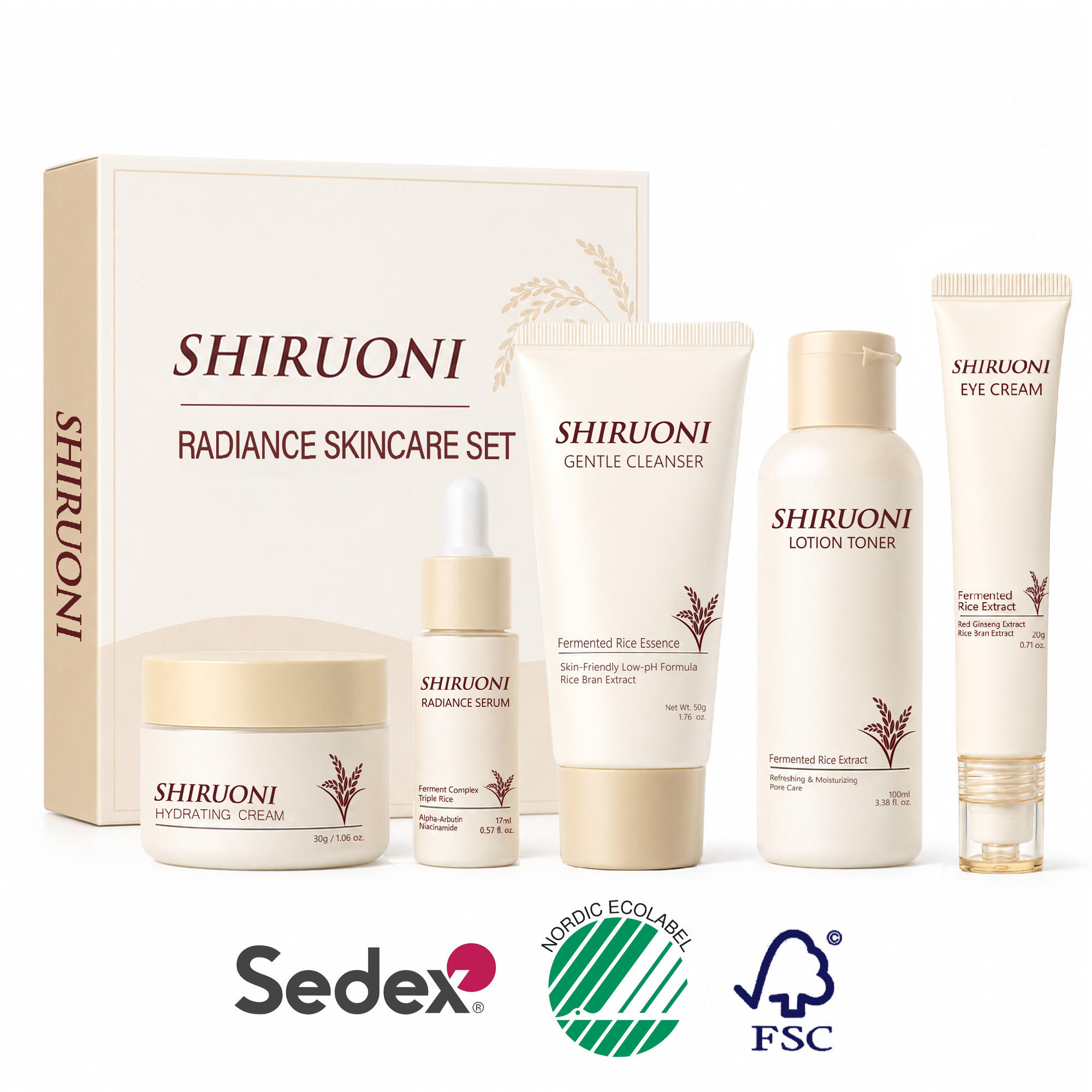
Manufacturer arrangements should mirror that split: lock the formula and packaging for steady items and agree safety stock levels; for test items, agree small-batch production windows and minimum conditions up front. Whether a factory can handle small batches quickly is a core evaluation criterion for cross-border brands. A multi-piece set such as this five-in-one facial care kit is a typical candidate for seasonal promotion slots.
The Document List the Factory Should Supply
Common listing documents include the full ingredient list, a finished-product test summary, origin information, a safety assessment summary and a responsible-party statement, with stability or compatibility notes requested in some categories. Writing this list into the supply agreement and pulling documents per listing saves weeks of back-and-forth. Production and quality systems are described in the workshop overview.
Cross-border channels are good at validating demand and poor at being a permanent single channel: platform rules shift and traffic costs rise. Use the marketplace to generate data, then deepen the proven products through general trade: for most brands that path is steadier. Requirements can be submitted through the contact page.
Frequently asked questions
Can you produce Cross-Border E-Commerce under our own brand?
Cross-Border E-Commerce is handled as a private label project: you bring the brand and the market position, we cover formula, bulk, filling and packing. Existing bases can be adjusted for texture, fragrance and active level, or we develop from a new brief. Tooling and artwork belong to you, and our name does not appear on the pack.
What is the minimum order quantity?
MOQ is set by net fill per unit: under 15 ml/g 5,000 pcs; 15-50 ml/g 3,000 pcs; 50-200 ml/g 2,000 pcs; above 200 ml/g 1,000 pcs. Several SKUs in one project can share a production run to reach the threshold.
How long do samples and bulk production take?
Samples take 7-10 working days from a confirmed brief, or 10-15 days when a new mould or artwork is involved. Bulk runs 25-35 days after sample approval and packaging arrival. Repeat orders with an unchanged formula usually move faster.
Which certificates and documents come with the shipment?
The plant runs under GMPC and ISO 22716 with a 100,000-class cleanroom. Each shipment can include COA, MSDS, the full INCI list, stability data and microbiological reports. For the EU we support CPSR and PIF paperwork; for other markets we prepare the file set your importer asks for.
Can we change the formula, fragrance or packaging?
Yes. Texture, viscosity, fragrance, colour and active percentage are adjustable within regulatory limits. Packaging can be sourced by you or by us: tubes, airless bottles, jars, sachets and aluminium foil bags, with silkscreen, hot stamping or label application.
What information do you need to quote?
Category and target function, quantity per SKU, packaging direction, destination market and launch date. With that we reply within 24 hours on business days with feasibility, MOQ and a price range. An NDA can be signed before formulas are discussed.
Need this produced? Talk to the factory.
Wangsha Bio has run OEM/ODM production since 2006: 60,000 sqm plant, 17 lines, 100,000-class cleanroom, GMPC and ISO 22716 certified. Send your brief and we reply within 24 hours on business days with feasibility, MOQ and a price range.
Email lucky@moksha-bio.com | Product range | Workshop