Qingyuan moksha Biotechnology Co., Ltd


A vitamin C serum is one of the best-selling products in any private label portfolio, and also one of the hardest to produce consistently. The active ingredient is prone to oxidation, the useful pH range sits in a zone that is uncomfortable for some skin types, and the same formula can perform differently depending on the bottle it ships in. If you are launching an antioxidant serum, most of the risk sits in formulation and packaging, not in marketing. Here is what brand owners should understand before placing a production order.
Why vitamin C is difficult to formulate
L-ascorbic acid is water-soluble, and in the presence of oxygen, light and trace metal ions it oxidises into dehydroascorbic acid and then into yellow-brown degradation products. Oxidation is not a defect that appears only after months on a shelf; it can begin during manufacturing if the process introduces oxygen or heat unnecessarily.
Three practical levers control it: pH, chelation and oxygen exclusion. A lower pH keeps ascorbic acid in its more stable, more absorbable form, but it also increases the chance of stinging. Chelating agents bind trace metals that catalyse oxidation. And filling under nitrogen, with minimal headspace, slows the reaction considerably.
Concentration and pH: the trade-off you have to choose
Higher concentration does not automatically mean better performance, and it always means more formulation difficulty. Concentrations in the 10 to 20 percent range are common in the market, and many brands find that a moderate concentration with a well-controlled pH delivers a better user experience than a maximum-strength formula that stings on application.
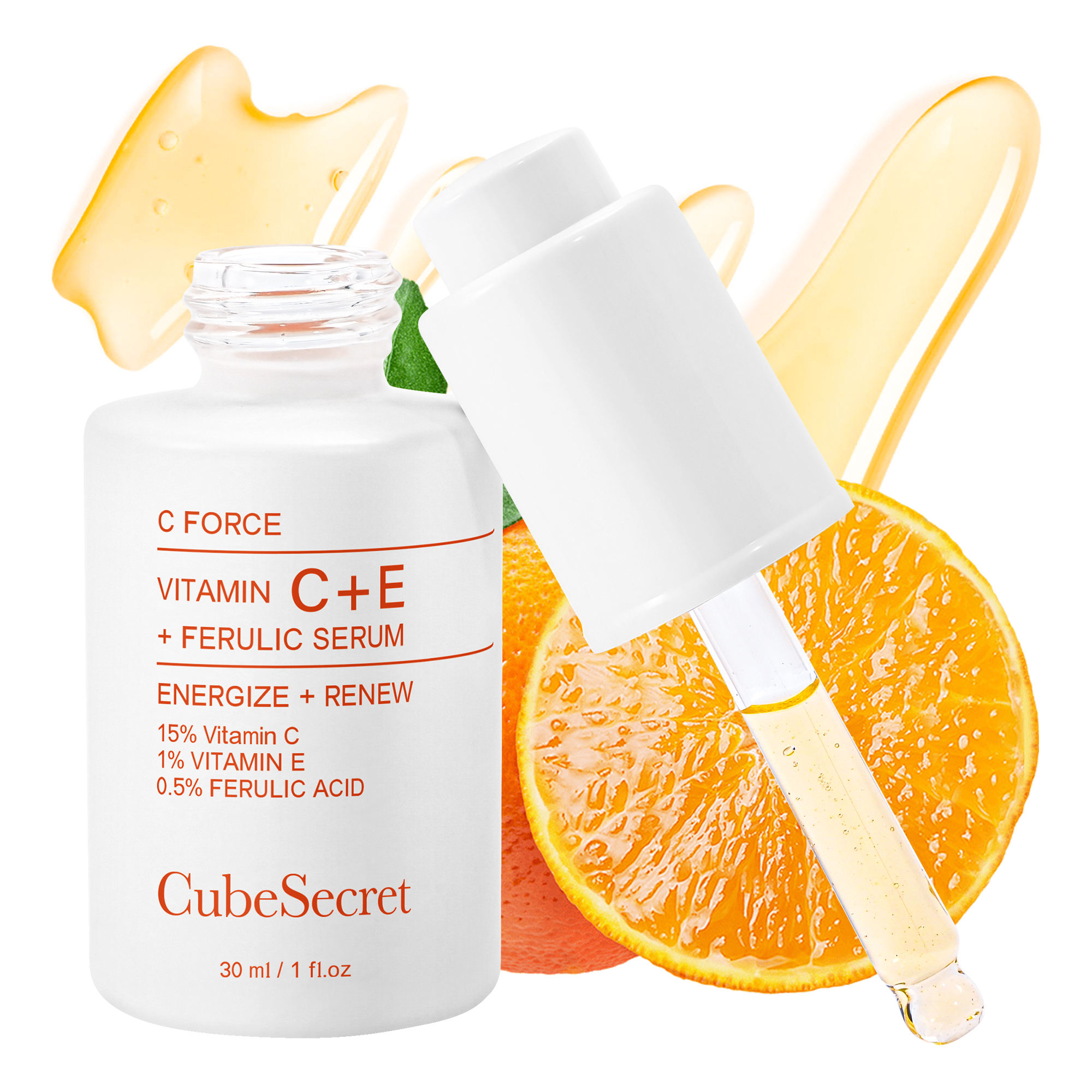
Adding vitamin E and ferulic acid together is a well-known approach, because the combination improves the stability of the system rather than simply stacking three actives. The point of a combination is to protect the formula, not to lengthen the ingredient list. See our vitamin C plus E ferulic serum for one way this is structured in production.
Packaging decides the shelf life
This is where many projects go wrong. A beautiful glass dropper bottle with a wide neck lets air in every time the user opens it; within weeks the serum starts to darken and the customer assumes the product is faulty.
Airless pumps, opaque or UV-protected containers, and smaller fill volumes all extend usable life. A 15ml airless bottle is often a better technical choice than a 30ml dropper, because the customer finishes the product before oxidation becomes visible. If you want a dropper for brand reasons, at least specify an amber or coated glass and a narrow neck.
Ask your manufacturer for compatibility data on the exact pack you intend to sell, not on a generic test bottle.
Testing protocol before launch
For an antioxidant serum, request at least the following:
- Accelerated stability at elevated temperature, with colour and pH measured at intervals
- Freeze-thaw cycling to confirm the emulsion or solution does not separate
- Assay testing of the active content at the start and end of the test period
- Preservative efficacy if the formula is water-based and multi-use
Colour change is the most visible failure mode and the one consumers notice first, so ask for photographic records across the test period rather than a simple pass or fail statement.
Claims that keep you compliant
Antioxidant serums sit in a category where claim wording matters. Avoid language that implies treating or curing a skin condition, and avoid absolute claims such as the best, the strongest, or completely safe. Describe what the formula contains and how it feels, and let the consumer draw the conclusion.
Wording such as brightening, antioxidant support, or helps protect against environmental stress is generally acceptable in most markets, but requirements differ by country and are updated regularly, so have the final copy reviewed before printing.
Working with a manufacturer
Ask your supplier three questions before sampling: how the ascorbic acid is protected during manufacturing, what the target pH and tolerance range are, and which pack formats they have already validated with this formula. A manufacturer that can answer all three has done this before.
You can review our product development range, check our manufacturing workshop, or submit your brief via the inquiry form.
In short: an antioxidant serum is a packaging and process project as much as a formula project. Get the pH, the chelation, the nitrogen blanket and the airless pump right, and the product will hold up on the shelf. Skip any one of them and you will be explaining colour change to customers instead of building repeat sales.
Frequently asked questions
Can you produce Vitamin C + E Ferulic Serum under our own brand?
Vitamin C + E Ferulic Serum is handled as a private label project: you bring the brand and the market position, we cover formula, bulk, filling and packing. Existing bases can be adjusted for texture, fragrance and active level, or we develop from a new brief. Tooling and artwork belong to you, and our name does not appear on the pack.
What is the minimum order quantity?
MOQ is set by net fill per unit, not by category:
| Net fill | MOQ |
|---|---|
| < 15 ml/g | 5,000 pcs |
| 15-50 ml/g (50 included) | 3,000 pcs |
| 50-200 ml/g (200 included) | 2,000 pcs |
| > 200 ml/g | 1,000 pcs |
Several SKUs in one project can share a production run to reach the threshold, and a smaller trial order is possible once the formula is approved.
How long do samples and bulk production take?
Samples take 7-10 working days from a confirmed brief, or 10-15 days when a new mould or artwork is involved. Bulk runs 25-35 days after sample approval and packaging arrival. Repeat orders with an unchanged formula usually move faster.
Which certificates and documents come with the shipment?
The plant runs under GMPC and ISO 22716 with a 100,000-class cleanroom. Each shipment can include COA, MSDS, the full INCI list, stability data and microbiological reports. For the EU we support CPSR and PIF paperwork; for other markets we prepare the file set your importer asks for.
Can we change the formula, fragrance or packaging?
Yes. Texture, viscosity, fragrance, colour and active percentage are adjustable within regulatory limits. Packaging can be sourced by you or by us: tubes, airless bottles, jars, sachets and aluminium foil bags, with silkscreen, hot stamping or label application.
What information do you need to quote?
Category and target function, quantity per SKU, packaging direction, destination market and launch date. With that we reply within 24 hours on business days with feasibility, MOQ and a price range. An NDA can be signed before formulas are discussed.
Need this produced? Talk to the factory.
Wangsha Bio has run OEM/ODM production since 2006: 60,000 sqm plant, 17 lines, 100,000-class cleanroom, GMPC and ISO 22716 certified. Send your brief and we reply within 24 hours on business days with feasibility, MOQ and a price range.
Email lucky@moksha-bio.com | Product range | Workshop