Qingyuan moksha Biotechnology Co., Ltd


Baby and kids personal care looks like a simplified version of adult products, and that is precisely where projects go wrong. The expectations are higher, the claims are watched more closely and the safety documentation is heavier, while the formula itself has fewer tools available. A children's product is judged on what it avoids as much as on what it contains. This article sets out the practical decisions behind a workable brief.
1. Formulation Baseline for Young Skin
Young skin has a thinner stratum corneum and a less developed barrier, so the formulation starts from a lower irritation budget. That means fewer ingredients, fragrance held back or removed, and a pH kept close to the skin's own range. Ingredient count is a design decision here, not a marketing afterthought.
Cleansers should be built around mild surfactants with low protein denaturation, and rinse-off products should leave minimal residue. Leave-on products such as lotions need emollients that support the barrier without occluding heavily. Where an adult product can add an active to fix a perceived weakness, a children's product is better off removing the risk. Formats already in production can be reviewed in the product range.
2. Surfactant Choice and Tear-Free Positioning
Tear-free is a formulation property, not a label claim to be added later. It depends on the surfactant system, the pH and the total active matter. Amphoteric and glucoside surfactants are common choices because they keep irritation low while still foaming acceptably. Tear-free performance has to be tested at the dilution the child actually experiences, not at neat concentration.
Foam quality matters more than foam volume in this category. Dense, quick-rinsing foam reduces the time product stays near the eyes. Viscosity should also be tuned so the product does not run into the eyes when applied to wet hair. Rinsing speed is one of the most underrated comfort factors in children's wash products.
3. Preservation and Safety Documentation
Preservation is harder than it looks, because the mild surfactant systems that suit children are often less hostile to microorganisms, and the fragrance-free direction removes another protective factor. A validated challenge test on the final formula is essential. Mild formulas and robust preservation have to be designed together, not traded against each other.
On documents, brand owners should expect ingredient safety assessments, allergen statements, heavy metal and microbiological test reports, and stability data at the intended storage conditions. Depending on the market, additional restrictions apply to specific preservatives, colourants and UV filters. The document set should be agreed at the brief stage, because it may rule out ingredients the formula already uses. Manufacturing and quality routines are outlined in the workshop overview.
4. Formats: Wash, Lotion and Bubble Cleanser
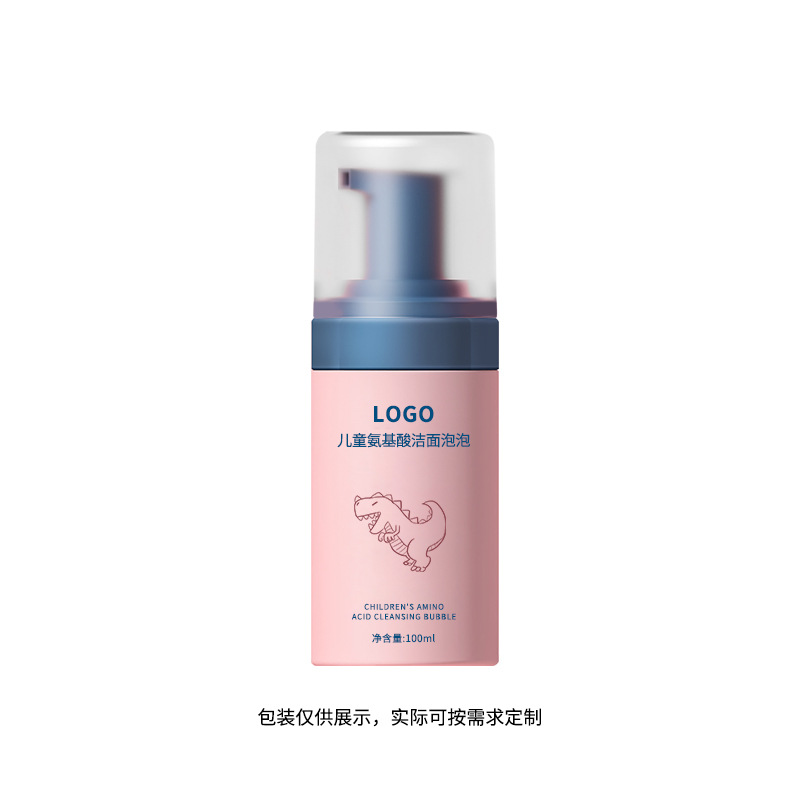
Shampoo and body wash in one format remains popular because it shortens the bath routine. Pump foaming cleansers avoid the child handling a slippery bottle and give a controlled dose, though they need a low-viscosity, low-surface-tension liquid that foams reliably at the pump. Lotions and balms cover the after-bath step. Format should be chosen around the adult doing the washing, since they control the dose.
Packaging should avoid sharp edges, small detachable parts and any closure a child can open. Decorations that look like food are a known safety concern in several markets and should be avoided at design stage. Child-resistant and child-appealing pull in opposite directions, and the safety side should win.
5. Claims, Labelling and Market Differences
Claim discipline is tighter in this category than almost any other. Wording should stay with cleansing, moisturising and comfort. Statements that suggest a therapeutic effect, or that imply suitability for every child including those with diagnosed skin conditions, should be left out. A cautious claim set protects the brand more than an expansive one, especially in the first year on shelf.
Labelling requirements differ by market, and age ranges for children's categories are defined locally rather than globally. A product positioned for children in one market may be classified differently in another, which changes both the test package and the artwork. Confirm the target market before the artwork is signed off, because the age definition drives the whole dossier. A reference mild cleansing format is listed on the children's cleansing bubble product page, and briefs can be submitted through the inquiry page.
Baby and kids care rewards restraint. Keep the ingredient list short, prove tear-free performance under real use conditions, validate preservation on the final formula, and align claims with the target market's rules.
Frequently asked questions
Can you produce Baby and Kids Personal Care OEM under our own brand?
Baby and Kids Personal Care OEM is handled as a private label project: you bring the brand and the market position, we cover formula, bulk, filling and packing. Existing bases can be adjusted for texture, fragrance and active level, or we develop from a new brief. Tooling and artwork belong to you, and our name does not appear on the pack.
What is the minimum order quantity?
MOQ is set by net fill per unit, not by category:
| Net fill | MOQ |
|---|---|
| < 15 ml/g | 5,000 pcs |
| 15-50 ml/g (50 included) | 3,000 pcs |
| 50-200 ml/g (200 included) | 2,000 pcs |
| > 200 ml/g | 1,000 pcs |
Several SKUs in one project can share a production run to reach the threshold, and a smaller trial order is possible once the formula is approved.
How long do samples and bulk production take?
Samples take 7-10 working days from a confirmed brief, or 10-15 days when a new mould or artwork is involved. Bulk runs 25-35 days after sample approval and packaging arrival. Repeat orders with an unchanged formula usually move faster.
Which certificates and documents come with the shipment?
The plant runs under GMPC and ISO 22716 with a 100,000-class cleanroom. Each shipment can include COA, MSDS, the full INCI list, stability data and microbiological reports. For the EU we support CPSR and PIF paperwork; for other markets we prepare the file set your importer asks for.
Can we change the formula, fragrance or packaging?
Yes. Texture, viscosity, fragrance, colour and active percentage are adjustable within regulatory limits. Packaging can be sourced by you or by us: tubes, airless bottles, jars, sachets and aluminium foil bags, with silkscreen, hot stamping or label application.
What information do you need to quote?
Category and target function, quantity per SKU, packaging direction, destination market and launch date. With that we reply within 24 hours on business days with feasibility, MOQ and a price range. An NDA can be signed before formulas are discussed.
Need this produced? Talk to the factory.
Wangsha Bio has run OEM/ODM production since 2006: 60,000 sqm plant, 17 lines, 100,000-class cleanroom, GMPC and ISO 22716 certified. Send your brief and we reply within 24 hours on business days with feasibility, MOQ and a price range.
Email lucky@moksha-bio.com | Product range | Workshop